 EN
EN
 English
 русский
 Español
Custom Industrial Cables: Materials, Certifications & Buying Guide
 2026.07.28
 Industry News
Content
- 1 What Is a Custom Industrial Cable?
- 2 Key Parameters to Specify for Your Custom Cable
- 3 Material Selection Guide: PVC vs. PUR vs. Rubber
- 4 Certification Requirements for Custom Cables (UL, CE, CCC)
- 5 The Custom Cable Manufacturing Process: Step by Step
- 6 Cost Considerations: MOQ, Material, and Lead Time
- 7 Common Applications and Cable Selection Tips
- 8 How to Request a Quote for Custom Industrial Cables
What Is a Custom Industrial Cable?
Every industrial application that demands more than an off-the-shelf cable starts with a single question: can this cable survive the actual operating conditions? A custom industrial cable answers that question with a design built to exact mechanical, thermal, and electrical requirements. Unlike standard stock cables, which are pre-manufactured in common configurations, a custom cable is engineered from the conductor up for a specific installation. That means you define the conductor stranding, insulation compound, jacket material, shielding architecture, and even the color coding.
The difference matters more than most buyers realize. Standard cables force compromises on bend radius, temperature range, and chemical resistance. Custom cables remove those compromises. They fit into tight drag chain tracks without premature fatigue, operate submerged in saltwater for years, or carry high-frequency VFD signals without radiating noise. The following guide breaks down the entire specification and sourcing process — from material selection to certification and cost — so you can move from concept to installation with confidence.
- Standard cable: fixed design, limited temperature/flex range, stock inventory, lower unit cost for repurposable applications.
- Custom cable: defined by your environmental, mechanical, and electrical parameters; extended service life in demanding conditions; higher per-meter cost offset by reduced downtime.
Key Parameters to Specify for Your Custom Cable
Every reliable custom cable design starts with five critical parameters. Failing to define even one can derail performance and lead to costly field failures.
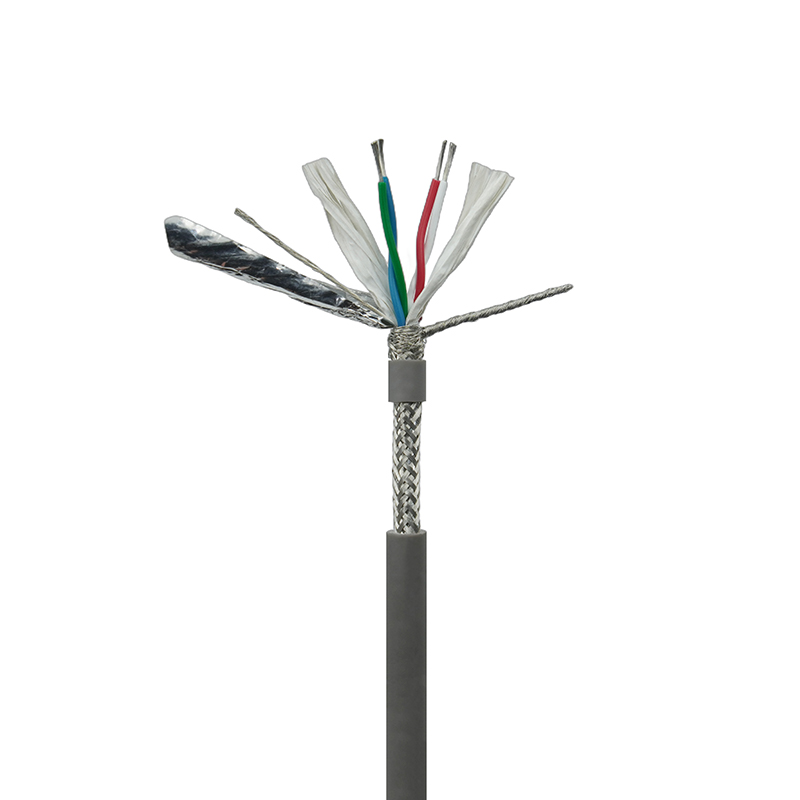
Conductor stranding directly determines flexibility and flex life. A 19-strand 0.16 mm copper construction bends more easily than a 7-strand 0.25 mm variant, and the finer stranding increases the number of flex cycles before a conductor breaks. Shielding type — braided, aluminum foil, or a combination — controls electromagnetic interference (EMI) rejection. Braided coverage above 85% suppresses high-frequency noise from 30 MHz upward; foil shields block lower frequencies but crack under continuous flex. Jacket material (discussed in detail below) sets the environmental envelope. The temperature rating defines the safe operating window, while the bending radius distinguishes fixed installation from continuous motion.
| Parameter | Options | Impact on Performance |
|---|---|---|
| Conductor Stranding | 7/0.25 mm, 19/0.16 mm, 37/0.10 mm | Finer stranding increases flexibility and bend life; 19-strand offers up to 40% longer flex life than 7-strand in motion applications. |
| Shielding | Braid (85% coverage), Foil (100%), Combo | Braid excels above 30 MHz; foil handles 1–30 MHz; combo provides full-spectrum EMI protection for VFD drives. |
| Jacket Material | PVC, PUR, Rubber | Determines oil, abrasion, and temperature resistance; PUR survives five times more Taber abrasion than PVC. |
| Temperature Rating | -60°C to +200°C | Exceeding the rating causes jacket cracking or insulation softening; select based on cold start and continuous operating temperature. |
| Bending Radius | 4x cable diameter (fixed) to 12x (continuous flex) | A smaller radius enables tighter routes but demands high-flex stranding and jacket material; undersized bends cause conductor fatigue in under 100,000 cycles. |
Material Selection Guide: PVC vs. PUR vs. Rubber
Choosing the wrong jacket material is the single most common mistake in custom cable projects. The table below compares the three dominant jacket compounds on the properties that matter most in industrial environments.
PVC remains the cost leader and works well indoors where minimal flexing and no oil exposure are expected. PUR takes the lead in dynamic applications — its abrasion resistance and notch sensitivity performance make it the standard for cable tracks and robotic arms. Rubber jackets, especially EPDM and chloroprene blends, handle extreme temperatures and outdoor UV exposure; they are the go-to choice for heavy-duty reeling cables and crane installations. The cost multiplier reflects not just raw material price but also the extrusion complexity and compound-specific certifications.
| Property | PVC | PUR | Rubber (EPDM/CR) |
|---|---|---|---|
| Temperature Range | -20°C to +105°C | -40°C to +80°C | -60°C to +200°C |
| Oil Resistance (ASTM D471) | Moderate | Excellent | Good |
| Abrasion Resistance (Taber) | Low | Very High | Moderate to High |
| Flexibility | Low | High | Moderate |
| Cost Index (per meter) | 1.0 | 2.5 | 2.0 |
| Typical Application | Control panels, indoor wiring | Drag chains, robotics, continuous flex | Reeling cables, outdoor cranes, mining |
Certification Requirements for Custom Cables (UL, CE, CCC)
No custom cable leaves the factory for a different market without facing a specific set of regulatory tests. The three most requested certifications — UL for North America, CE under the European Construction Products Regulation, and CCC for China — carry distinct flame test procedures and marking rules. A design that passes one may fail another if the jacket chemistry or insulation wall thickness wasn't optimized upfront.
UL 2464 and UL 1277 focus on appliance wiring and tray cable, respectively, with the VW-1 vertical flame test being a common requirement. European EN 50525 mandates cable performance under fire using a more stringent bundle burn test (CPR class B1 or higher in many cases). China’s GB/T 5023-based CCC mark demands specific conductor cross-sections and insulation resistance values that sometimes conflict with North American AWG tables. Auditing the certification path before freezing the design can save months of re-certification.
| Certification | Market | Key Standard | Flame Test | Marking Required |
|---|---|---|---|---|
| UL | North America | UL 2464, UL 1277 | VW-1 (vertical wire) | UL logo, style number, voltage |
| CE | Europe | EN 50525, CPR | EN 60332-1-2 (single) or bundle test for B1 | CE mark, CPR class, manufacturer ID |
| CCC | China | GB/T 5023, JB/T 8734 | GB/T 18380 (IEC equivalent) | CCC logo, standard number, voltage |
The Custom Cable Manufacturing Process: Step by Step
A transparent manufacturing workflow removes uncertainty and keeps projects on schedule. The typical sequence divides into four stages, each with clear deliverables and review gates.
- Requirement Confirmation. You submit a detailed specification sheet covering all parameters from conductor size to outer jacket appearance. The engineering team reviews feasibility and flags any conflicting requirements. Completion: 1–2 working days.
- Engineering Drawing & Sample. A digital drawing and, when needed, a 3–5 meter physical sample are produced. You approve the construction, dimensions, and printing layout. This stage typically takes 3–5 working days.
- Pilot Production. A small batch (usually 100–500 meters) is extruded and fully tested against agreed electrical and mechanical values. Design adjustments are made before mass production. Duration: 7–15 days.
- Mass Production & Final Testing. Full-scale production runs with in-line and completed-cable tests — dielectric strength, insulation resistance, bending endurance, and, where applicable, certification witness testing. Delivery-ready spools ship within 15–30 days of pilot approval.
| Stage | Duration | Deliverable |
|---|---|---|
| Specification & Feasibility | 1–2 days | Technical proposal, cost estimate |
| Drawing & Sample | 3–5 days | CAD drawing, sample length |
| Pilot Run | 7–15 days | Pre-production batch, test report |
| Mass Production & QC | 15–30 days | Certified cable on spools, inspection documents |
Cost Considerations: MOQ, Material, and Lead Time
Custom cable pricing does not follow a linear curve. Minimum order quantities (MOQ) heavily influence the per-meter rate, especially for small runs. A 200-meter order of PUR cable costs roughly 40% more per meter than a 5,000-meter production batch because setup time, extrusion die changes, and testing amortize over fewer meters. Raw material choice amplifies this effect: PVC carries a cost index of 1.0, rubber is roughly 2.0 times the cost, and PUR reaches 2.5 times the base PVC cost.
Shielding complexity also adds cost layers. A simple aluminium foil wrap with a drain wire costs less than a high-coverage tinned copper braid. Combination shielding — foil plus braid — raises the material and labor cost further but is often mandatory for VFD applications. Budget for a 15–25% price premium when specifying dual-layer shielding.
| Material | 100 m MOQ | 1,000 m MOQ | 5,000 m MOQ |
|---|---|---|---|
| PVC | 1.5 | 1.0 | 0.9 |
| Rubber | 3.0 | 2.0 | 1.8 |
| PUR | 3.8 | 2.5 | 2.2 |
Common Applications and Cable Selection Tips
Every industrial sector presents its own set of motion, environmental, and signal challenges. The table below maps five common applications to the custom cable configurations that deliver reliability.
| Application | Recommended Cable Type | Key Selection Criteria |
|---|---|---|
| High-flex drag chains | Drag chain cable (PUR jacket, 19-strand copper, braided shield) | Bend radius ≤12× diameter, ≥10 million flex cycles, oil-resistant |
| Underwater ROV / submersible | Floating cable (foam-filled, Kevlar strength member, PUR/PE jacket) | IP68, buoyancy ratio 1.05–1.15 g/cm³, water-blocking tape |
| VFD motor integration | VFD cable (symmetrical 3+3 construction, heavy-duty copper braid) | Low capacitance (<75 pF/m), 100% EMI shielding, 2 kV voltage spikes |
| Crane and hoist reeling | Reeling cable (rubber jacket, steel support core) | Tensile strength ≥15× cable weight, -40°C cold flex, UV-stable |
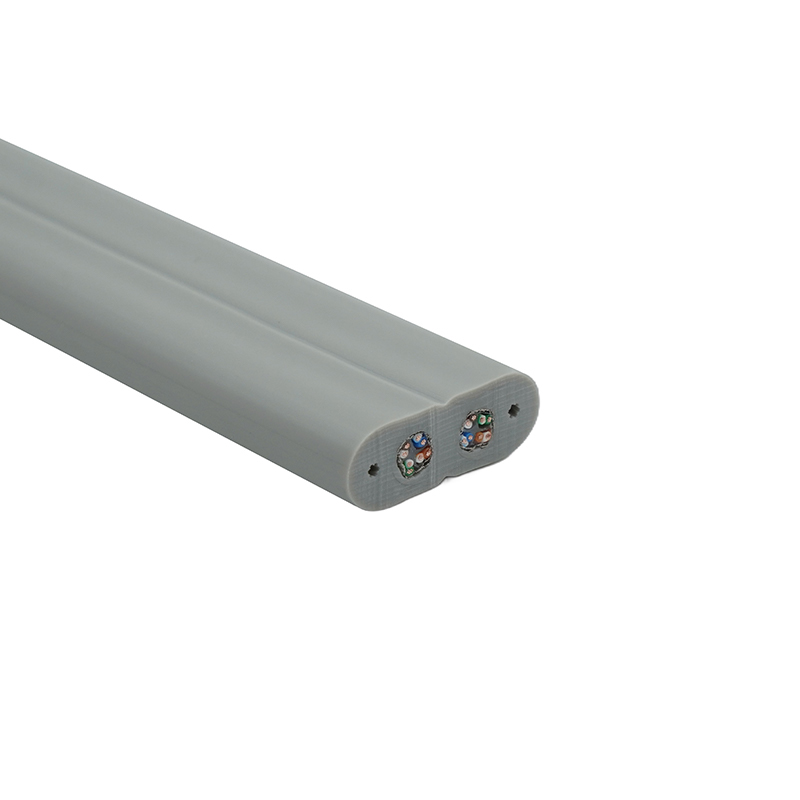
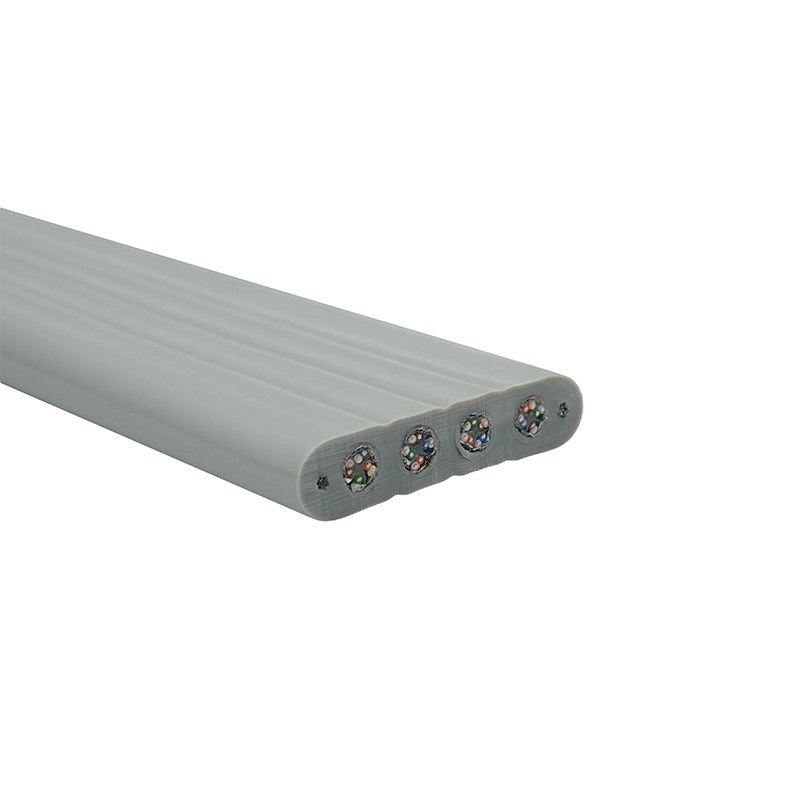
| Elevator traveling | Flexible flat cable (PVC or PUR, integrated steel tension wires) | Flat profile, <5% elongation under load, vertical travel up to 100 m |
Selecting a cable tailored to the motion profile and environment eliminates the guesswork that shortens service life. For instance, a standard screened cable in a VFD loop may show a common-mode noise voltage spike above 200 V; a properly designed VFD cable reduces that spike by more than 90%, protecting motor windings and inverter electronics.
How to Request a Quote for Custom Industrial Cables
A precise quote request shortens the entire procurement cycle. The following checklist covers the minimum information required for a manufacturer to generate an accurate proposal within 24 to 48 hours.
- Conductor size and number of cores (e.g., 4×2.5 mm² or 19 AWG, 5 conductors)
- Rated voltage (300/500 V, 600/1000 V, etc.)
- Insulation material (PE, XLPE, PVC, FEP)
- Jacket material (PVC, PUR, rubber — specify compound if known)
- Shielding requirements (braid coverage %, foil type, combination)
- Outer diameter constraints (max. OD in mm)
- Operating temperature range (minimum cold start, maximum continuous)
- Flexing condition (static, continuous flex, torsional, reeling)
- Target certifications (UL, CE, CCC, CSA, etc.)
- Desired quantity and target lead time
Attaching a dimensioned sketch or a sample of the existing cable accelerates the engineering review significantly. A complete submittal package reduces the average quotation turnaround by half and avoids the back-and-forth that delays production starts.