 EN
EN
 English
 русский
 Español
Types of Cable Shielding: Foil, Braid, Spiral & More
 2026.03.03
 Industry News
Content
Cable shielding is a conductive layer wrapped around a cable's inner conductors to block electromagnetic interference (EMI) and radio frequency interference (RFI). The four main types of cable shielding are foil shielding, braided shielding, spiral (serve) shielding, and combination shielding — each suited to different environments, frequencies, and flexibility requirements. Choosing the wrong type can result in signal degradation, data errors, or complete system failure, so understanding the differences is critical before specifying any cable for industrial, audio, or data applications.
Foil Shielding
Foil shielding consists of a thin layer of aluminum or copper bonded to a polyester film. It provides 100% coverage of the conductors beneath it, making it one of the most effective barriers against high-frequency EMI (typically above 100 kHz).
How It Works
The metallic foil acts as a Faraday cage, reflecting and absorbing incoming electromagnetic fields. A drain wire runs along the inside of the foil to provide a continuous ground path, which is essential — foil alone without grounding offers minimal protection.
Typical Applications
- Cat5e and Cat6 twisted pair network cables (F/UTP construction)
- Audio and instrumentation cables in studio environments
- Data cables running near fluorescent lighting or variable frequency drives
Limitations
Foil shields are fragile. Repeated bending causes the foil to crack and lose continuity. They are generally rated for static or low-flex installations only. Typical foil thickness ranges from 0.025 mm to 0.05 mm — thin enough that mechanical stress quickly creates gaps in coverage.
Braided Shielding
A braided shield is woven from fine strands of bare or tinned copper wire in an interlocking mesh pattern around the cable core. Unlike foil, it does not offer 100% coverage — typical braid coverage ranges from 85% to 98% — but it excels in mechanical strength and low-frequency performance.
Shielding Effectiveness by Frequency
Braided shields perform best at frequencies below 10 MHz. Above that range, the openings in the braid allow higher-frequency signals to pass through. For low-frequency noise, such as 50/60 Hz power line interference, a braid with 90%+ coverage provides excellent attenuation — often exceeding 60 dB at these frequencies.
Typical Applications
- Coaxial cables (RG-58, RG-6) for RF and video transmission
- Industrial control cables subject to continuous flexing
- USB, HDMI, and other high-cycle connector cables
- Military and aerospace wiring where mechanical durability is critical
Key Advantage: Flex Life
Braided cables in continuous-flex applications (like robotic arms or cable drag chains) can achieve millions of flex cycles before failure, compared to foil shields that may crack after a few hundred. This makes braiding the standard choice wherever cables move continuously.
Spiral (Serve) Shielding
Spiral shielding — also called serve shielding or helical shielding — wraps wire strands in a tight helix around the cable core rather than weaving them into a mesh. The result is a highly flexible shield with coverage rates similar to braiding (95–98%), but with different mechanical and electrical characteristics.
Flexibility vs. Stability Trade-off
Spiral shields are the most flexible of all shield types, making them ideal for handheld microphone cables, headphone cables, and other hand-flex applications. However, stretching the cable causes the helix to open up, reducing coverage and increasing impedance. Spiral shields should never be used in applications where the cable will be pulled taut.
Typical Applications
- Professional audio cables (XLR microphone leads, instrument cables)
- Medical device cables requiring repeated coiling and uncoiling
- Handheld tool cables and portable equipment leads
Combination Shielding
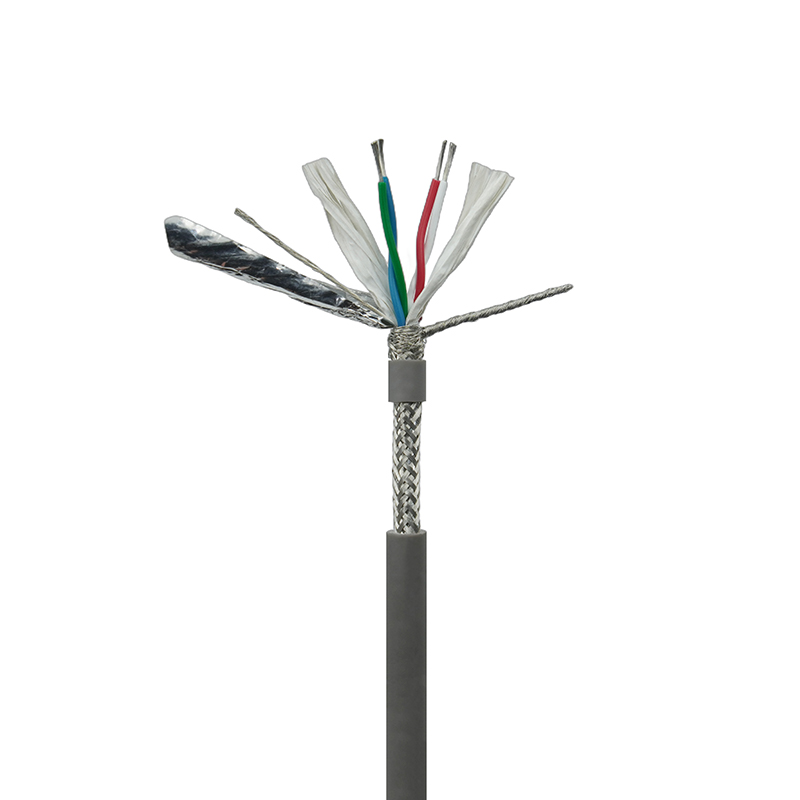
Combination shields stack two or more shielding types to address the limitations of each individual method. The most common combination is foil + braid, but foil + spiral and double-braid constructions also exist.
Foil + Braid: The Industry Workhorse
In this construction, a foil layer provides 100% coverage for high-frequency noise, while an outer braid provides structural integrity and low-frequency attenuation. This combination is common in high-performance data cables like Cat7 (S/FTP), where individual pairs are foil-shielded and the overall cable has a braided outer shield. Typical shielding effectiveness in this configuration exceeds 90 dB across a wide frequency range.
Double Braid
Two braided layers, often wound in opposite directions, are used in demanding RF coaxial cables (such as RG-11 or certain plenum-rated coax) where maximum low-frequency shielding and mechanical protection are both required. The opposing lay angles also improve the cable's resistance to transfer impedance degradation over time.
Typical Applications
- High-speed data networks in electrically noisy industrial environments
- Broadcast and RF cabling requiring both broadband shielding and flex durability
- Aerospace, defense, and medical instrumentation cables
Comparison of Cable Shielding Types
The table below summarizes the key characteristics of each shielding type to help in selection:
| Shield Type | Coverage | Best Frequency Range | Flex Rating | Relative Cost | Typical Use |
|---|---|---|---|---|---|
| Foil | 100% | High (>100 kHz) | Low (static only) | Low | Network, data, instrumentation |
| Braided | 85–98% | Low–mid (<10 MHz) | High (continuous flex) | Medium | Coax, industrial, robotics |
| Spiral | 95–98% | Low–mid | Very high (hand flex) | Low–medium | Audio, medical, portable tools |
| Combination (Foil+Braid) | ~100% | Broadband | Medium–high | High | Cat7, broadcast, defense |
Shield Coverage Ratings Explained
Shield coverage is not the same as shielding effectiveness. Coverage is a geometric measurement — what percentage of the underlying conductor surface is wrapped by the shield material. Effectiveness (measured in dB) describes how much the shield actually attenuates an interfering signal.
A foil shield at 100% coverage may deliver only 40–50 dB of attenuation at low frequencies because the thin film has higher resistance. A braided shield at 90% coverage can reach 60 dB or more at the same frequencies because copper braid has lower transfer impedance. Always evaluate shielding effectiveness figures alongside coverage percentages when comparing cables.
Grounding: The Factor Most Often Overlooked
No shielding type functions correctly without proper grounding. An ungrounded shield can actually worsen EMI performance by acting as an antenna that couples interference into the signal conductors. The correct grounding approach depends on the application:
- Single-end grounding (at the source end only): Recommended for audio and analog signal cables to prevent ground loops. Common in balanced XLR installations.
- Both-end grounding: Required for high-frequency data cables (Ethernet, coax) to provide a low-impedance return path at RF frequencies. Cat6A and Cat7 cables require both-end grounding to meet their rated shielding performance.
- Multi-point grounding: Used in long industrial runs to prevent differential ground potentials from building up along the cable length.
In a 2019 study of industrial Ethernet installations, over 40% of EMI-related failures were attributed to improper shield grounding rather than inadequate shield type — reinforcing that the best cable specification on paper will fail without correct termination practice.
How to Choose the Right Cable Shielding Type
Use the following decision points to narrow down the appropriate shielding for a given installation:
- Identify the interference frequency: High-frequency EMI above 100 kHz calls for foil or combination shielding. Low-frequency magnetic interference from motors or power lines calls for braided shielding.
- Assess flex requirements: Static fixed runs tolerate foil. Continuous machine flex requires braid. Human-hand flex (audio, medical) works best with spiral.
- Check connector compatibility: Braided shields terminate easily with standard backshells and clamps. Foil requires a drain wire termination — if your connectors don't accommodate a drain wire, reconsider the shield type.
- Review applicable standards: In some industries, shielding requirements are mandated. For example, IEC 61000-4 EMC standards and MIL-DTL-17 for military coax specify minimum shielding performance levels that constrain your options.
- Factor in total installed cost: Combination-shielded cables cost 30–60% more than single-shield equivalents. For benign environments, that premium is not justified — reserve it for genuinely hostile EMI conditions.