 EN
EN
 English
 русский
 Español
Flat Cable Guide: Types, Structure & Industrial Applications Explained
 2026.03.09
 Industry News
Content
- 1 What Is a Flat Cable and Why Does It Matter in Industrial Settings?
- 2 Common Flat Cable Types and Their Designations
- 3 Internal Structure: What Makes a Flat Cable Perform Under Stress
- 4 Key Applications: Where Flat Cables Are Deployed
- 5 Installation Guidelines and Operating Limits
- 6 How to Select the Right Flat Cable for Your Project
- 7 Flat Cable vs. Round Cable: When Flat Wins
What Is a Flat Cable and Why Does It Matter in Industrial Settings?
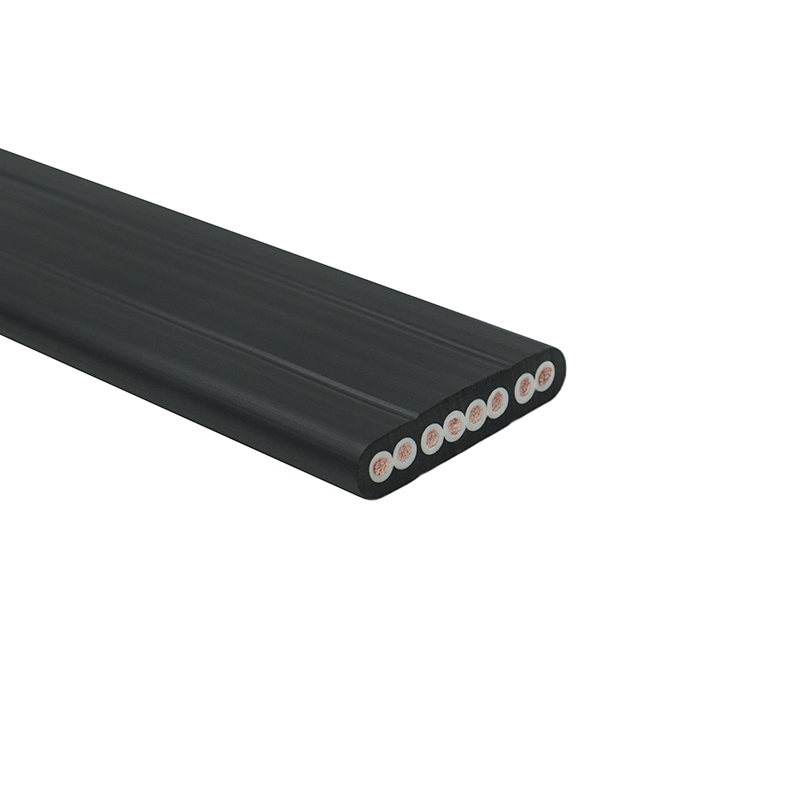
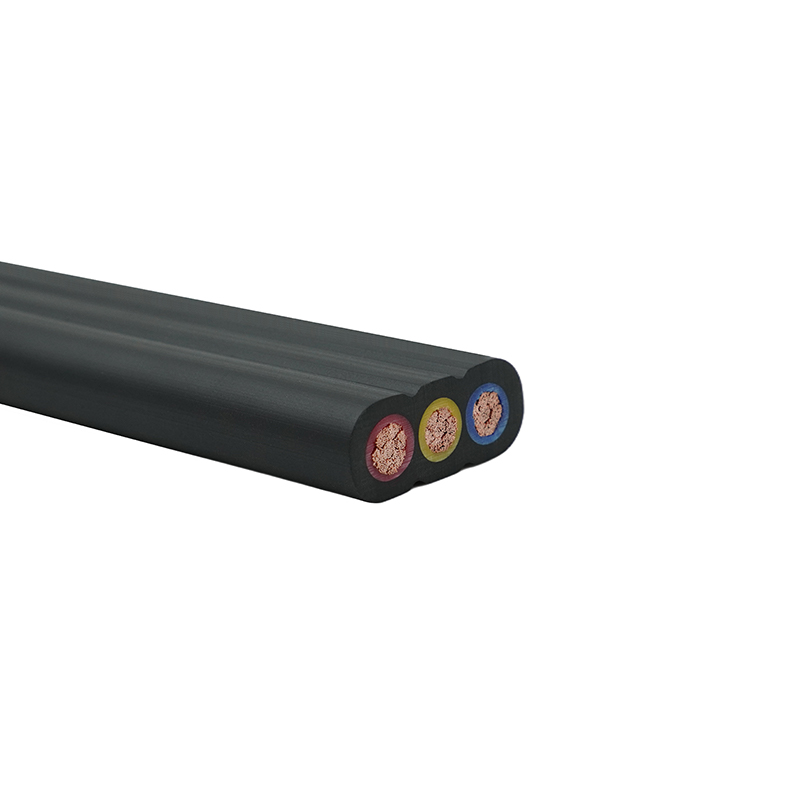
A flat cable is a specially structured power and control cable designed for use in continuously moving equipment such as cranes, hoists, elevators, and conveyor systems. Unlike round cables, its flat profile allows it to hang freely or coil neatly without tangling or kinking — making it the preferred choice wherever cables must move repeatedly over long service lives.
In heavy industrial environments, cable failure isn't just a maintenance headache — it can halt production lines, create safety hazards, and generate significant downtime costs. Flat cables are engineered specifically to withstand the mechanical stresses of dynamic applications, and understanding their construction, types, and correct usage conditions is essential for engineers, procurement specialists, and facility managers.
Common Flat Cable Types and Their Designations
Flat cables follow standardized naming conventions. Each letter in the designation carries a specific meaning that tells you how the cable is constructed and where it is suitable for use. The most common series include:
- YFFB — Rubber-insulated, rubber-sheathed flat flexible cable; suitable for outdoor and heavy-duty environments.
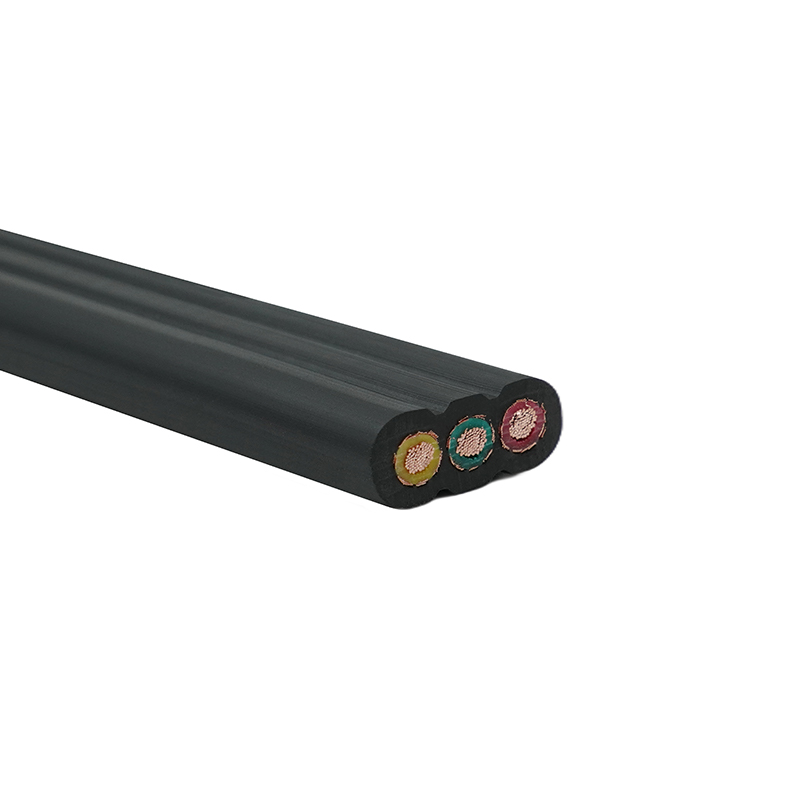
- TVVB — PVC-insulated, PVC-sheathed flat flexible cable for elevator and lift systems.
- H07VVH6-F — European standard flat cable rated at 450/750V for general industrial use.
- A05VVH6-F / A07VVH6-F — Lighter-duty flat cables for lower-voltage control and signal applications.
Additional suffix letters modify the base type:
- P — Indicates a shielding layer, typically braided copper shielding, for improved EMI protection in electrically noisy environments.
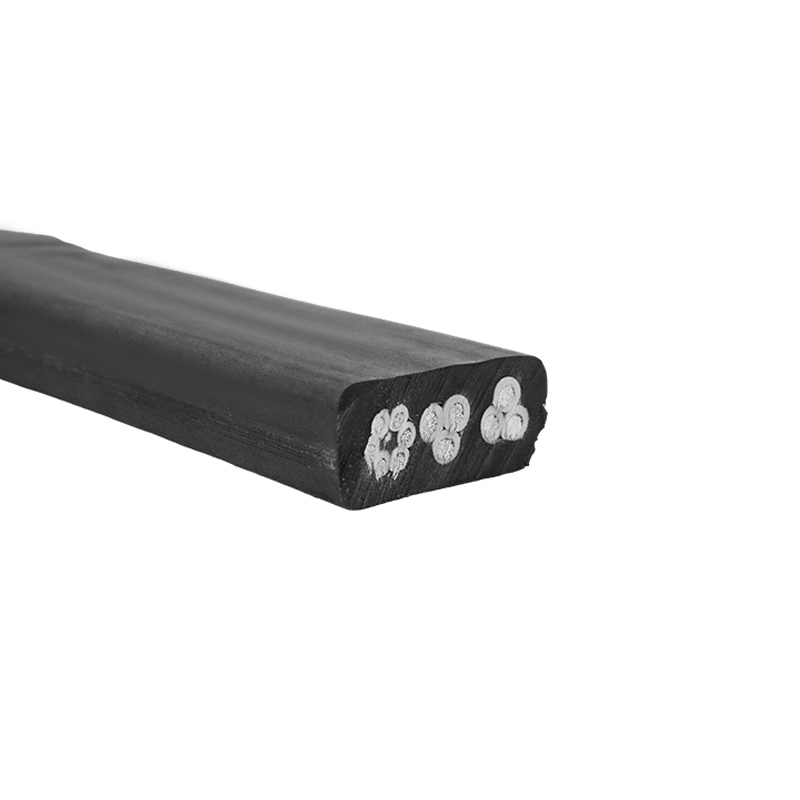
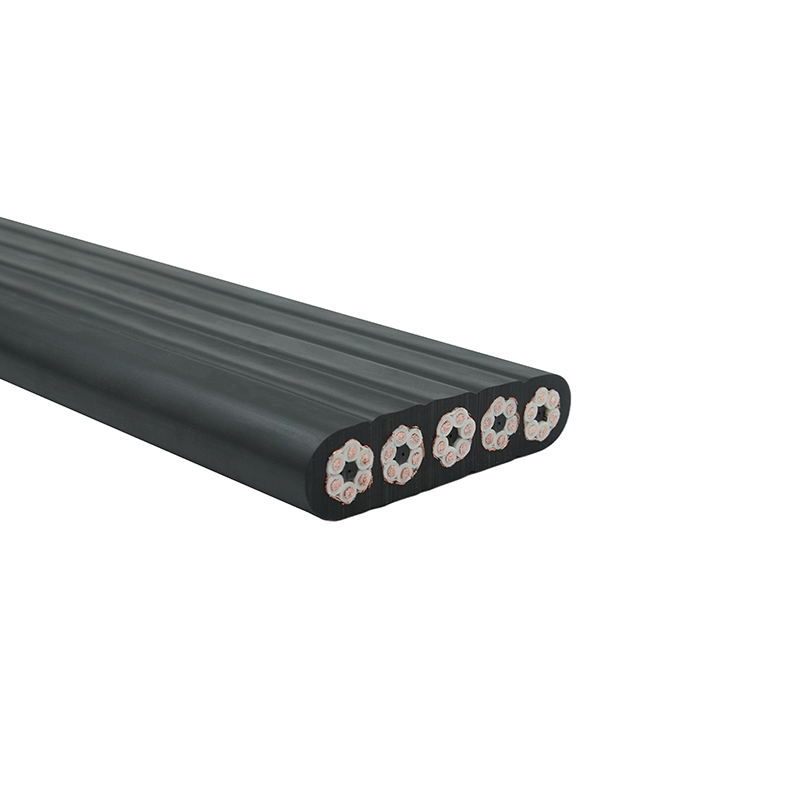
- G — Indicates added steel wire rope for enhanced tensile strength, critical for long free-hang applications.
- J — Indicates galvanized steel wire strands, functionally similar to G, offering additional mechanical reinforcement.
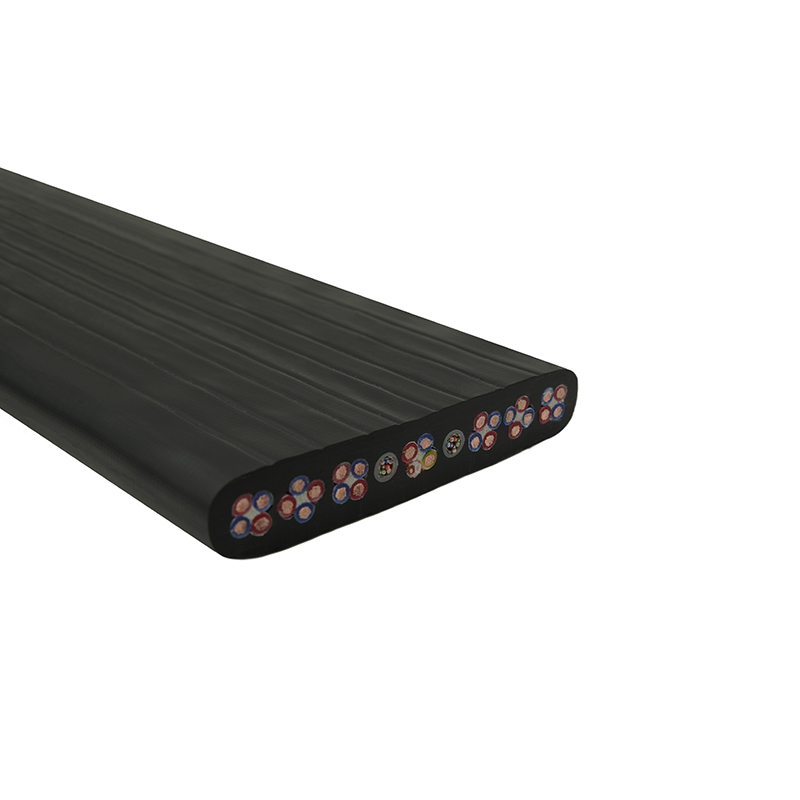
Custom variants including fiber optic cores, signal lines, and network cables integrated within the flat structure are also available upon request — particularly useful in smart crane and automated warehouse systems where data transmission runs alongside power delivery.
Internal Structure: What Makes a Flat Cable Perform Under Stress
The durability of a flat cable in dynamic applications comes down to the quality of each internal layer. Here is how each component contributes to performance:
Conductor
The conductor is made from multi-strand fine-wire oxygen-free copper, compliant with VDE0295 CLASS 5. This high strand count makes the conductor extremely flexible — able to endure hundreds of thousands of bending cycles without fatigue cracking. Oxygen-free copper also resists oxidation over time, maintaining low resistivity throughout the cable's service life.
Insulation
Individual conductors are insulated with brightly colored, flame-retardant, hybrid PVC. Colors comply with 227IEC standards — brown, black, blue, and yellow/green — enabling clear identification during installation and maintenance. Where fluoroplastic insulation is required for higher temperatures, black or white number coding compliant with EN50124 is applied instead.
Outer Sheath
The outer jacket uses a heavy-duty, heat-resistant, flexible PVC/TPR (thermoplastic rubber) compound. This material combination provides:
- Abrasion resistance in dusty factory and warehouse environments
- Flame retardancy to slow fire propagation
- Flexibility at temperatures as low as -40°C, making it suitable for cold storage facilities and outdoor winter operation
Standard sheath colors include black (RAL9005), grey (RAL7001), and orange (RAL2001), with color customization available for project-specific requirements.
Key Applications: Where Flat Cables Are Deployed
Flat cables are purpose-built for environments where cables must move continuously along a defined path. Typical deployment scenarios include:
| Application | Movement Type | Typical Requirement |
|---|---|---|
| Overhead cranes | Horizontal traversal | High tensile strength, long free-hang |
| Hoists & chain blocks | Vertical lift | G/J steel reinforcement |
| Passenger & freight elevators | Vertical reciprocation | Flexible at low temp, TVVB series |
| Conveyor systems | Horizontal + lateral | Abrasion resistance, flame retardancy |
| Automated guided vehicles (AGVs) | Multi-directional | Shielded (P type) for signal integrity |
| Scissor lift platforms | Vertical extension/retraction | Compact routing, high flex cycles |
Installation Guidelines and Operating Limits
Correct installation is just as important as choosing the right cable type. Improper setup — especially in crane and hoist applications — leads to premature wear, conductor fatigue, and potentially dangerous failures. The following parameters should be observed:
Free-Hanging Length and Travel Speed
- For heavy-duty crane traction: free-hanging length should not exceed 35 meters, and travel speed should remain at or below 1.8 m/s.
- For continuous reciprocating suspended configurations with a control bracket: free-hanging length can extend up to 80 meters, with travel speeds between 4.0 m/s and 10.0 m/s.
Exceeding these limits without adding a tension member will place excessive mechanical load on the conductors themselves, leading to conductor breakage over time.
When to Add a Tension Member
Whenever the cable operates near or beyond its free-hang limits, a tension member must be added. The standard solution is a galvanized soft steel wire rope run alongside or integrated into the cable body. This transfers the gravitational and dynamic load away from the electrical conductors, dramatically extending service life in high-travel applications.
Temperature Considerations
Standard flat cables with hybrid PVC sheathing maintain flexibility down to -40°C. For applications in freezer warehouses, outdoor northern climates, or cold-chain logistics facilities, confirm that the selected cable grade carries this rating. Standard PVC cables without the low-temperature compound may stiffen and crack at sub-zero temperatures, creating installation and safety problems.
How to Select the Right Flat Cable for Your Project
Selecting a flat cable requires answering several key questions upfront. Rushing this step leads to over-specification (wasted budget) or under-specification (early failure). Work through the following checklist:
- What is the voltage and current rating? — Determine the power supply voltage (e.g., 300/500V or 450/750V) and the maximum continuous current to size the conductor cross-section correctly.
- What is the movement type and frequency? — Vertical reciprocation, horizontal traversal, and multi-axis movement each impose different fatigue profiles on the cable.
- What is the free-hanging length? — Exceeding 35m in traction mode requires G or J type reinforcement, or a separate tension wire.
- Is EMI shielding required? — If the cable runs near inverter drives, welding equipment, or high-frequency machinery, choose a P (shielded) variant.
- What is the operating temperature range? — Specify low-temperature-rated sheathing for cold environments.
- Are there special needs? — Signal lines, fiber optics, or network cables can be integrated into custom flat cable designs by the manufacturer.
For non-standard requirements — unusual cross-sections, special colors, integrated data lines, or unique sheath materials — manufacturers like Jiangsu Junshuai Special Cable Technology Co., Ltd. offer full custom engineering support including design-to-drawing, sample matching, and OEM/ODM production.
Flat Cable vs. Round Cable: When Flat Wins
For static installations, round cables are often sufficient and cost-effective. But in dynamic, moving applications, flat cables consistently outperform:
- Torsional stability: Flat cables resist twisting during travel, while round cables can rotate and tangle inside cable carriers or festoon systems.
- Space efficiency: The flat profile coils tightly into a neat stack, reducing the footprint of cable management systems on crane bridges and gantries.
- Flex life: Multi-strand fine-wire conductors in flat cable construction are optimized for cyclic bending, routinely achieving 1 million+ flex cycles in qualified designs.
- Predictable hang behavior: Flat cables hang in a consistent, controlled plane — critical for safe and reliable operation of elevator and hoist systems.
That said, flat cables are not universal replacements. For fixed conduit runs, underground installations, or high-voltage power distribution, standard round cables remain the appropriate choice. The key is matching cable type to the mechanical demands of the application.