 EN
EN
 English
 русский
 Español
How to Choose Shielded Drag Chain Cables: EMI Control Guide
 2026.01.26
 Industry News
Content
- 1 Start With the EMI Risk Inside Your Drag Chain
- 2 Define Your Signal Types: Servo Power vs Encoder vs Bus
- 3 Select the Shield Architecture That Matches Your EMI Problem
- 4 Grounding and Shield Termination: Where EMI Control Usually Fails
- 5 Flex Life and Shield Stability: EMI Performance Must Survive Motion
- 6 Jacket Material Choice: PUR vs TPE/PVC for EMI-Sensitive Machines
- 7 Drag Chain Installation Rules That Protect Servo, Encoder, and Bus Signals
- 8 A Practical Selection Checklist We Use Before Finalizing a Quote
- 9 Where Our Shielded Drag Chain Cable Options Fit (Without Forcing a Match)
Start With the EMI Risk Inside Your Drag Chain
In real automation projects, “random” faults in servo feedback, encoder position, or fieldbus communication are often not random at all—they are the predictable result of electromagnetic interference (EMI) coupling into moving cables. A drag chain concentrates motion, power switching, and long parallel cable runs into a tight space, so the cable construction and shielding strategy matter as much as the PLC or drive brand.
Before you choose a shielded drag chain cable, identify which symptom you are trying to eliminate. In our manufacturing support work, the most common EMI-driven symptoms include:
- Servo “following error,” occasional overshoot, or drive alarms that correlate with acceleration/deceleration.
- Encoder count jumps, unstable homing, or intermittent “encoder communication” faults.
- Bus CRC/frame errors, dropouts, or devices intermittently disappearing during high-current events (motor start, braking, welding, contactor switching).
Once you know which signal is failing (servo feedback, encoder/resolver, RS-485/CAN/Ethernet-based fieldbus, or mixed I/O), you can select the correct shield architecture and grounding method instead of “over-shielding” everything and still seeing problems.
Define Your Signal Types: Servo Power vs Encoder vs Bus
A drag chain often carries multiple functions in one moving route. The right cable choice depends on whether you are transmitting high dV/dt power, low-level differential signals, or impedance-controlled data. Mixing them without a plan is the fastest way to create EMI trouble.
Typical circuits inside servo/robot drag chains
- Servo motor power (U/V/W + PE), sometimes with motor brake conductors.
- Encoder/resolver feedback (often differential pairs, sometimes with power for the encoder).
- Fieldbus or machine network (RS-485, CAN, PROFINET/EtherNet-based protocols, proprietary buses).
- Auxiliary sensors, I/O, and control signals (24 VDC, analog, safety circuits).
| Signal in the drag chain | Most common EMI issue | Preferred cable construction | Installation focus |
|---|---|---|---|
| Servo motor power | Radiated noise coupling into nearby feedback/bus | Purpose-built servo/VFD-style shielded power cable | 360° shield termination; separation from signal pairs |
| Encoder/resolver feedback | Bit errors / count jumps from common-mode noise | Shielded twisted pairs; ideally pair-balanced construction | Short shield bonds; avoid long “pigtails”; clean 0V reference |
| RS-485 / CAN bus | Reflections + EMI pickup causing CRC/frame errors | Twisted pair with controlled impedance; shield when routed near power | Correct termination; topology control; bonding strategy |
| General 24V control / sensors | Switching spikes; cross-talk between channels | Overall shielded multi-core control cable when needed | Routing discipline; segregate analog from power |
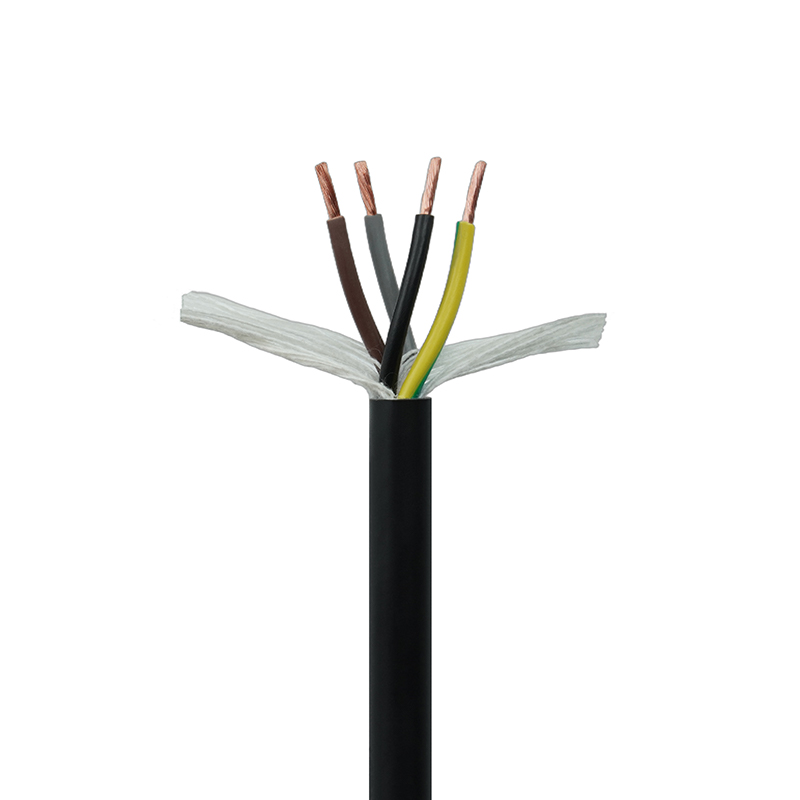
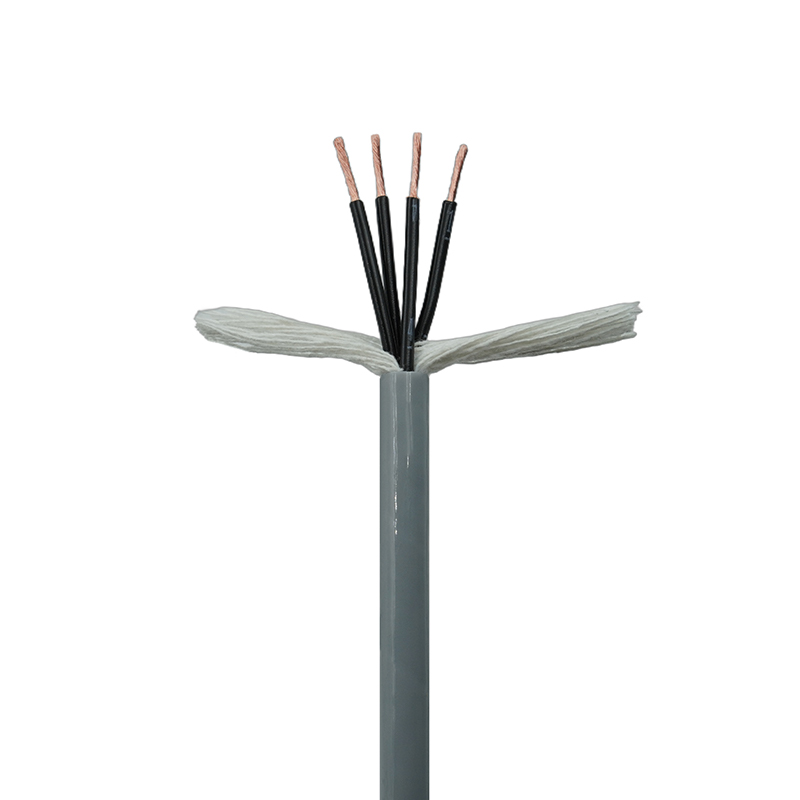
If you want to compare the typical constructions we supply for moving applications, you can reference our Drag Chain Cable product category page and match it to your signal mix and environment.
Select the Shield Architecture That Matches Your EMI Problem
“Shielded” is not one design. What matters is how well the shield maintains coverage and low impedance during continuous bending, and whether it is the right style (overall vs pair shielding) for servo/encoder/bus signals.
Braid shielding: the practical default for moving drag chains
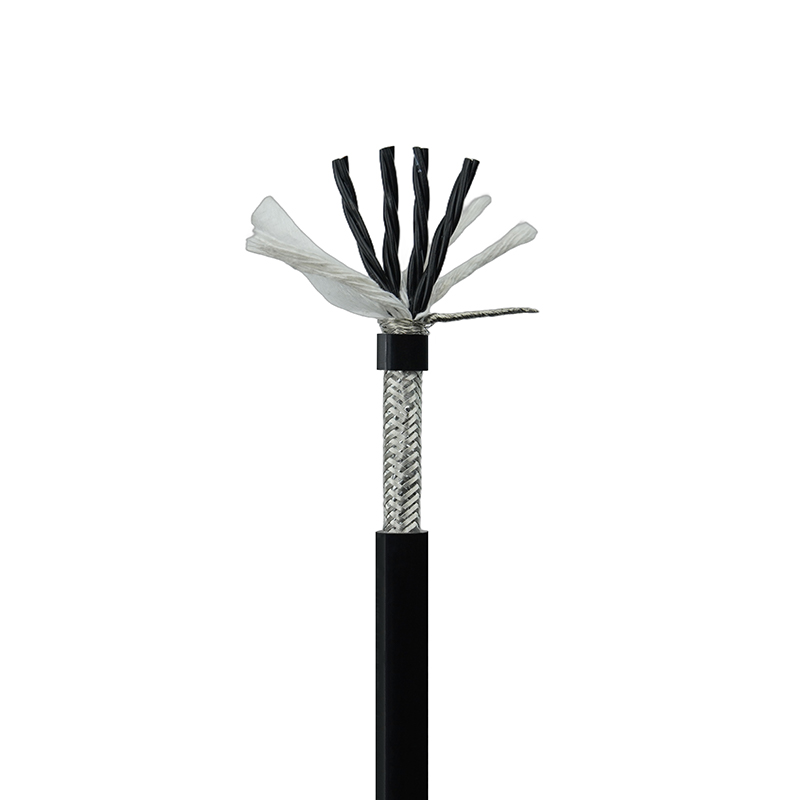
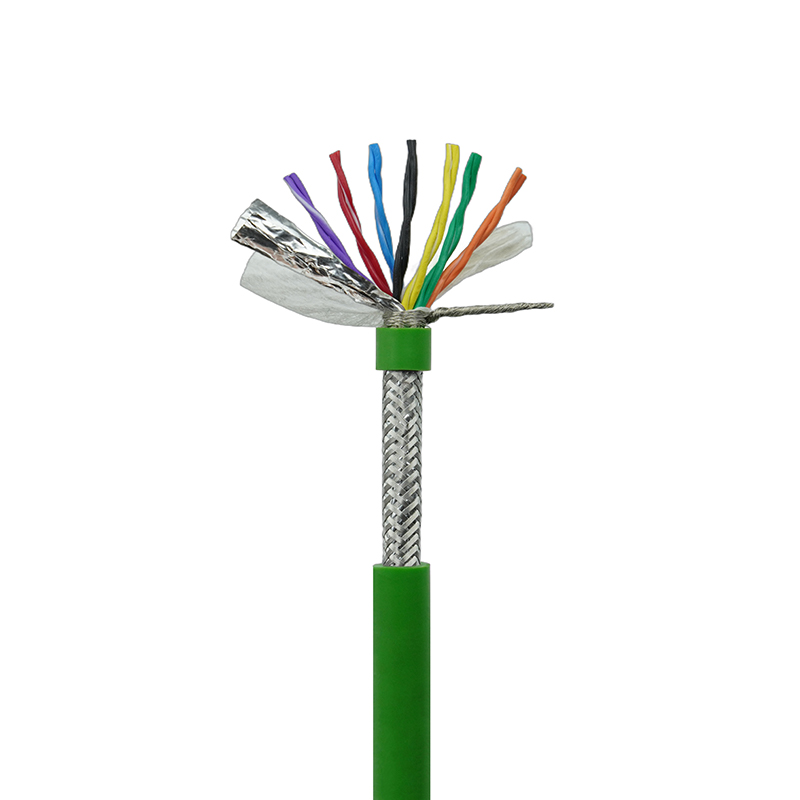
For dynamic applications, braided shields are widely used because they survive flexing better than foil-only shields. In one of our common high-flex shielded drag chain constructions, we use a tinned copper braided shield with 80% coverage, and we also focus on shield stability during high-frequency movement by managing shield wear and transfer impedance (≤50 mΩ/m @100 MHz) through the overall structure.
When the machine environment is harsh (oil mist, abrasion, or vibration), braid plus a mechanically stable lay is usually more durable than relying on a thin foil layer alone.
Overall shield vs individually shielded pairs
- Overall shield is effective for reducing external EMI pickup across the whole cable and is a strong baseline for mixed control wiring.
- Twisted pairs are critical for encoder and bus signals because twisting cancels common-mode noise and reduces loop area.
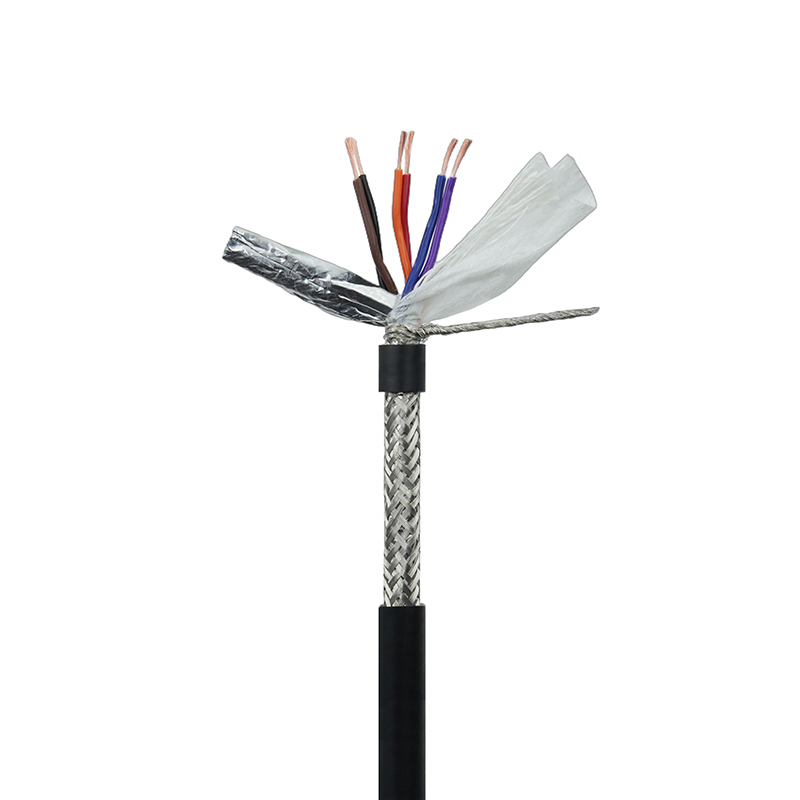
- Individually shielded pairs become valuable when you have multiple sensitive channels in the same cable (multi-axis feedback, mixed analog + digital, or high-speed bus next to switching lines).
For projects that need a high-flex, shielded twisted-pair option in the drag chain, we often recommend a construction like our Flexible Shielded Twisted Pair Drag Chain Cable page as a reference point for the mechanical and EMI balance.
Grounding and Shield Termination: Where EMI Control Usually Fails
Even the best shielded drag chain cable can underperform if the shield is terminated incorrectly. In servo and bus systems, the “weak link” is often the last 20 mm: long pigtails, poor clamp contact, or inconsistent bonding between cabinet and machine frame.
Our field rule: bond the shield like an RF component
High-frequency interference does not behave like DC. If you terminate a shield with a long drain wire, you add inductance and the shield becomes less effective exactly where you need it most. For servo drives, encoders, and fast bus signals, a 360° clamp at the entry point (EMC gland or shield clamp to the grounded backplate) is usually the most reliable approach.
Bonding strategy for bus signals (example: RS-485)
For RS-485 specifically, correct signal integrity and EMI control go together: use a twisted pair, terminate the trunk ends with 120 Ω, keep stubs short, and choose shielding when routing is near drives or contactors. If you want a practical, engineering-style reference, see our RS-485 communication cable selection guide page.
- Clamp the shield with a 360° connection at the cabinet entry (not only at the terminal).
- Maintain the twist right up to the connector/terminal for differential pairs (encoder/bus).
- Keep shield “tails” as short as possible; avoid long drain-wire pigtails on high-frequency systems.
- Ensure the cabinet ground, machine frame, and drive PE are bonded with low impedance; otherwise the shield can carry unwanted circulating currents.
Practical note: If your installation has known ground potential differences, the bonding plan should follow your site EMC standard. The cable shield is for noise control, not for carrying normal return current.
Flex Life and Shield Stability: EMI Performance Must Survive Motion
In a drag chain, EMI control is not only electrical—it is mechanical. If the shield abrades the insulation during repeated bending, or the cable “pumps” inside the chain, the EMI performance degrades over time and you see intermittent faults months after commissioning.
Look for structures that prevent shield wear during bending
One design approach we use in high-flex shielded drag chain cables is adding an isolation layer between the braid shield and the sheath, reducing friction and helping the shielding stay stable during continuous movement. This matters because a shield that “saws” against adjacent layers is a common long-term failure mechanism in dynamic routing.
Mechanical reinforcement for long travel
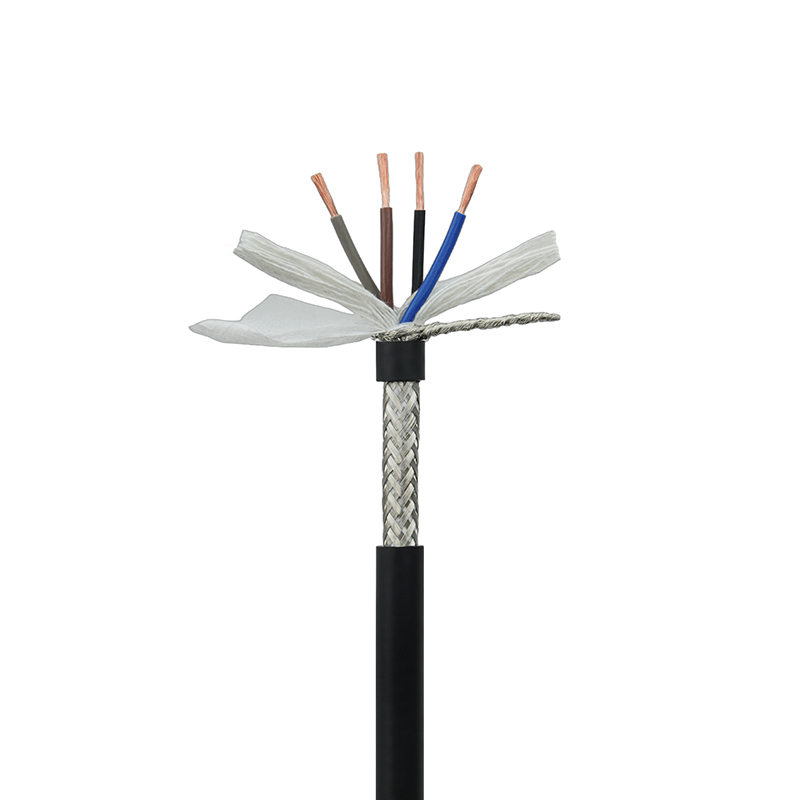
For long travel lengths, tensile stress and micro-stretch can impact both conductor integrity and signal stability. In one of our shielded high-flex drag chain constructions, we apply a layered stranding approach and reinforcement so the conductor breaking strength can be increased by about 40%, supporting towline applications up to ≤50 m when the overall chain design is appropriate. If you are reviewing shielded multi-core control options, you can use our TRVVP High-Flex Shielded Drag Chain Cable page as a reference for these structural concepts.
Jacket Material Choice: PUR vs TPE/PVC for EMI-Sensitive Machines
Shielding solves EMI coupling, but jacket material determines whether the cable maintains its geometry and durability under real operating conditions. When a jacket cracks or deforms, the cable lay changes, shields loosen, and EMI performance can drift.
When PUR is the safer choice
For outdoor equipment, oil exposure, abrasion, and cold bending, PUR jackets are often preferred. In one of our high-flex PUR shielded drag chain designs, we target a working range of -30℃ to +100℃ with low-temperature flexibility (no cracking in bending at -30℃) and UV aging resistance up to Grade 8 (ISO 4892-3). We also reinforce mechanical protection with a thicker sheath (about +20% vs ordinary constructions), impact strength around 15 kJ/m², and short-term pressure tolerance up to 500 N without damage in typical handling scenarios.
If your application involves outdoor robots, port machinery, or aggressive abrasion risk in the drag chain, you can reference our TRVVP-PUR High-Flex Polyurethane Shielded Drag Chain Cable page for the performance targets we design around.
When TPE/PVC-type jackets still make sense
- Indoor machines with stable temperature and moderate abrasion where cost efficiency is important.
- Control cabinets to moving sections where the chain speed and travel are moderate and coolant exposure is minimal.
- Applications where the primary requirement is flexibility and cable management rather than chemical/UV durability.
Drag Chain Installation Rules That Protect Servo, Encoder, and Bus Signals
In manufacturing, we can build a cable to high specs, but the drag chain system can still create EMI and early failure if the installation ignores the cable’s dynamic needs. The following practices are the ones that most consistently reduce commissioning problems.
Maintain bend radius and avoid internal abrasion
High-flex designs often allow tighter dynamic bending than conventional flexible cables. For example, one of our shielded twisted-pair drag chain constructions targets a bending radius down to 6× the cable outer diameter (versus ~8× for conventional products) and a bending resistance of ≥1,000,000 cycles in a 180° reciprocating bending test, with higher-cycle options available for demanding equipment. The goal is not to bend as tightly as possible, but to keep the cable operating in its stable mechanical range for years.
Separate “noise sources” from “noise victims”
- Do not bundle servo power cables tightly together with encoder/bus pairs for long parallel distances in the chain.
- If you must cross, cross at 90° outside the chain where possible.
- Use proper strain relief at both chain ends so the shield termination does not see repeated flex stress.
Preserve the shield connection in moving systems
Treat shield termination as part of the EMI design: use shield clamps or EMC glands, maintain clean metal contact, and avoid routing that forces the termination point to flex. This is especially important for encoder and bus pairs where small noise changes can create protocol or position errors.
A Practical Selection Checklist We Use Before Finalizing a Quote
As a manufacturer and supplier, we can make shielded drag chain cables in many constructions, but the best results come when the selection is driven by measurable conditions. These are the questions we typically confirm with customers to avoid overspecification or (worse) intermittent EMI faults after startup.
- Which signals are in the chain: servo power, brake, encoder/resolver, RS-485/CAN/Ethernet bus, analog sensors?
- What is the travel length, speed, acceleration profile, and minimum bend radius of the chain?
- Is there nearby VFD/servo output wiring in the same tray or cabinet section?
- What is the environmental exposure: oil/coolant, welding spatter, outdoor UV, low temperature, chips/abrasion?
- How will the shield be terminated (EMC glands, shield clamps, backplate bonding)? One end or both ends per your EMC standard?
- Do you require compliance markings or documentation (UL/CE/RoHS) for the target market?
If you can share these parameters early, we can propose the right shield type, pair structure, and jacket material without trial-and-error during commissioning.
Where Our Shielded Drag Chain Cable Options Fit (Without Forcing a Match)
Different machines call for different constructions. For example, encoder/bus stability often benefits from shielded twisted pairs, while mixed control wiring in a noisy automation line often benefits from an overall braided shield with a mechanically stable structure. For outdoor or abrasive environments, PUR jacketed shielded drag chain designs can materially improve durability and shield integrity over time.
If you want to browse what we manufacture across moving, shielded, and specialty cable families, please use our products page as the starting point, and then narrow to our Drag Chain Cable category page for high-flex and shielded options used in servo, encoder, and industrial bus applications.
If your application is borderline (long travel, high speed, heavy EMI, mixed power + signal in one chain), we recommend treating the cable as part of the system design: select the correct shield architecture, confirm the termination plan, and then validate bend radius and routing so the EMI solution survives motion for the full service life.