 EN
EN
 English
 русский
 Español
Crane Festoon Systems: Flat Cable Selection, Installation & Maintenance Guide
 2026.09.28
 Industry News
Content
- 1 How a Crane Festoon System Is Put Together
- 2 Flat or Round Festoon Cable?
- 3 Matching the Cable Construction to the Crane Duty
- 4 Setting the Loop Geometry: Travel, Sag and Trolley Spacing
- 5 Installation and Maintenance Practices
- 6 Festoon, Conductor Bar or Cable Reel?
- 7 Getting the Specification Right the First Time
A crane festoon system is the quiet workhorse behind power delivery on most overhead travelling cranes. A row of trolleys rides along a track, carrying a looped flat cable that pays out and gathers slack as the bridge, trolley and hoist move. Because the cable never winds onto a drum and never rubs against a bare conductor, wear stays gentle and predictable, provided the cable itself was built for the duty.
We have supplied festoon and travelling cables for cranes, hoists and automated storage systems for years, and the same questions come up in every project: which track, how many trolleys, how deep the loop, and which construction survives the cycle count. This article answers them in the order they usually appear in a real specification.
How a Crane Festoon System Is Put Together
A festoon system is a mechanical cable management arrangement, not a power source. Electricity comes from the building supply; the festoon simply carries it to a machine that moves. Five elements have to work together, and a weak link in any one of them shortens cable life.
- Support track – C-track, square rail, I-beam flange or tensioned wire rope, selected according to span, load and the mounting space available.
- Trolleys – rolling carriers fitted with cable saddles. Smooth-running wheels matter more than catalogue load ratings, because a trolley that binds will drag the cable sideways.
- Towing trolley – the driven carrier that pulls the loop. It should be linked to the crane movement by a towing arm or a small drag chain, so the cable is never used as a pulling member.
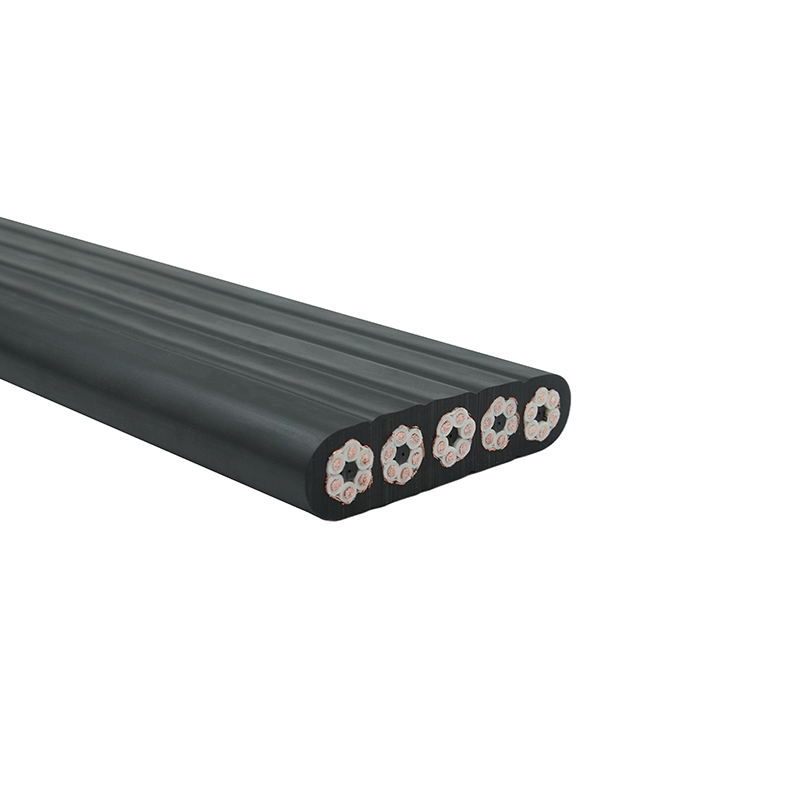
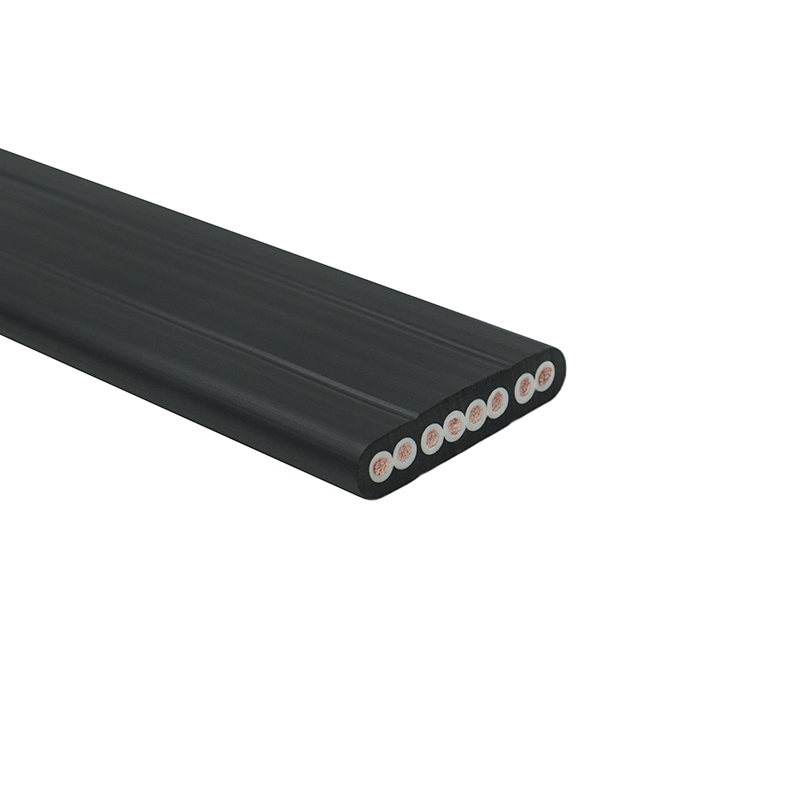
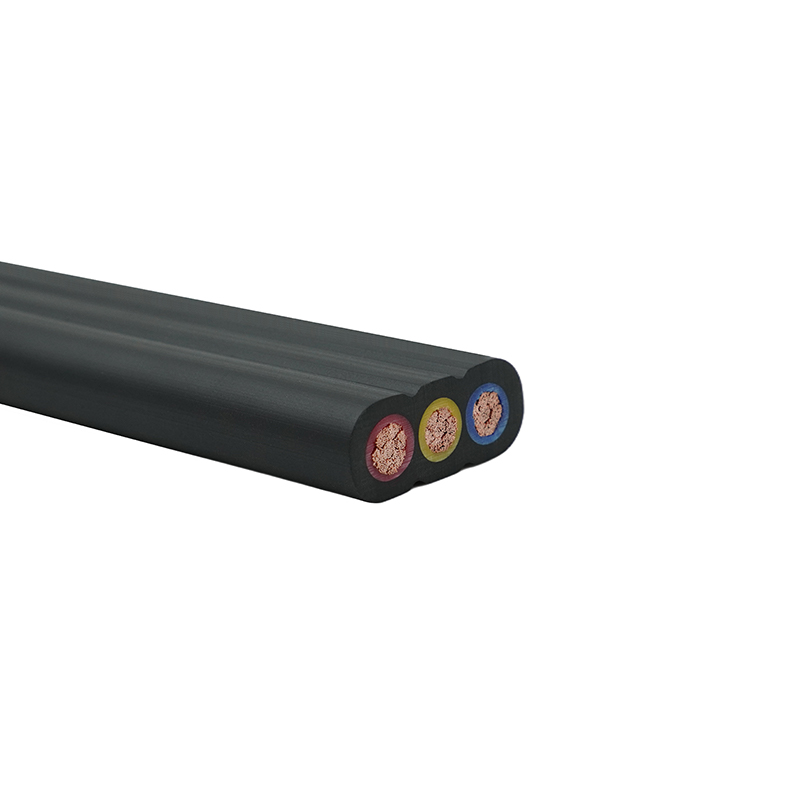
- Festoon cable – the flexible flat or round cable that carries power and control circuits. Conductor size, sheath compound and core arrangement all matter.
- Clamps and strain relief – the fixed ends and saddles that spread mechanical load away from conductor terminations.
Where a crane has both long travel and cross travel, designers often use two festoon circuits at right angles, or a festoon on one axis and a reeling cable on the other. Mixing the two is normal and rarely causes trouble, as long as each cable is specified for its own motion pattern.
Flat or Round Festoon Cable?
Both work, and both are common on modern cranes. The decision usually comes down to available headroom, loop behaviour and how the cable will be terminated.
| Feature | Flat festoon cable | Round festoon cable |
|---|---|---|
| Loop stacking | Stacks neatly, cores stay in order | Tends to twist, needs more care |
| Space required | Shallower loop for the same core count | Deeper loop or more trolleys |
| Bending direction | Flexes in one plane, matching the track | Flexes in all directions |
| Termination | Needs a flat-cable gland or spreader | Standard round glands |
| Cable weight | Lower for the same conductor area | Heavier, more load per trolley |
| Typical use | Crane travel, hoists, storage machines | Retrofit loops, short runs, mixed circuits |
For most new crane projects a flat travelling cable is the simplest answer: it hangs in a tidy stack, keeps the loop shallow, and allows more cores in less height. Round cable still has a place, especially where a plant is adding a small loop to existing equipment and standard glands are already in stock.
Matching the Cable Construction to the Crane Duty
Conductor Size and Voltage Drop
Festoon runs are longer than people expect, because the cable must follow the full travel plus the loop. On a 60 m runway, the conductor may need to cover 75 m or more. Size the cores for the motor current first, then check voltage drop at the far end of travel. Control and brake circuits deserve their own calculation, since a few volts lost can make a contactor chatter or a brake release late.
Sheath Compounds: Where the Crane Actually Lives
The environment decides the sheath. PVC is fine indoors and dry. Polyurethane handles abrasion, oil mist and repeated flexing on foundry and port cranes. Rubber and silicone formulations suit heat, cold or outdoor UV exposure. It is worth reading a wider material comparison before you fix a compound, because the wrong choice usually shows up as a cracked sheath in the second year, not the first week.
Steel Wire, Shielding and Hybrid Cores
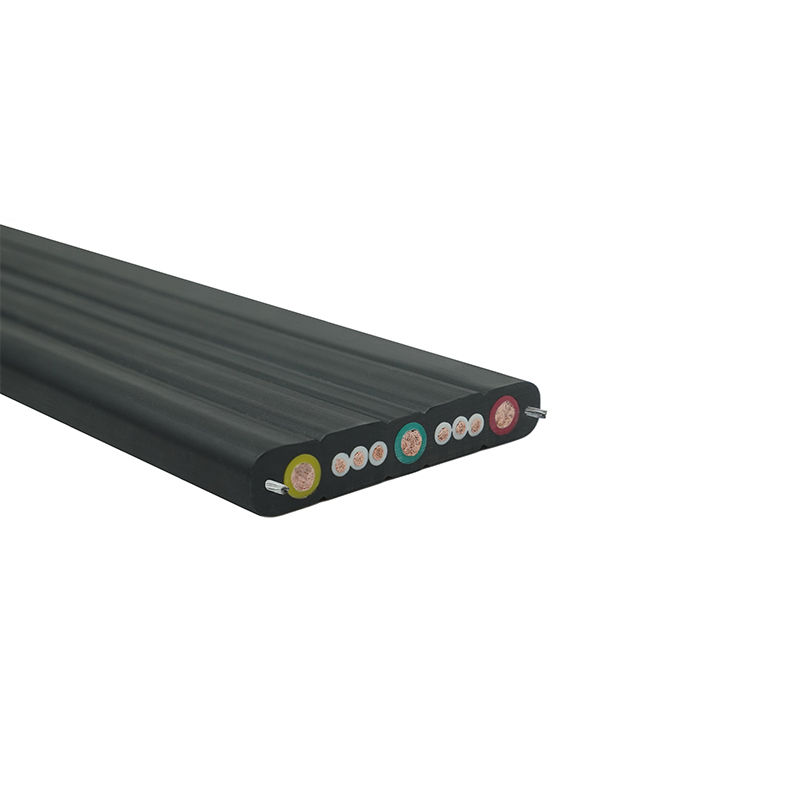
Long spans pull hard, so many crane cables carry a steel support element that takes the tension while the copper cores stay relaxed. This is the single most effective way to stop a loop from stretching and losing its shape over time.
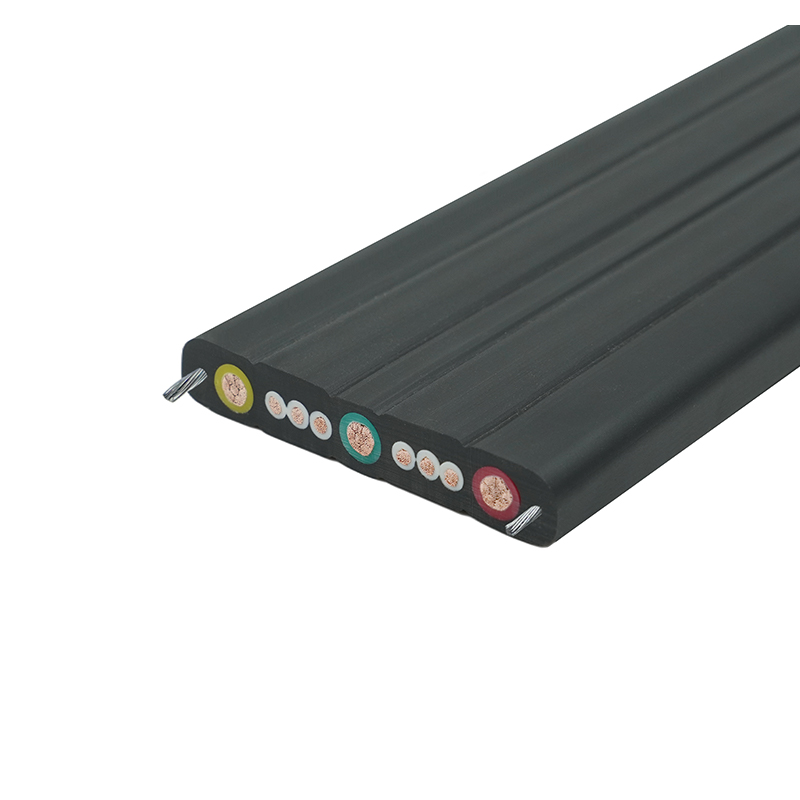 Compound Sheath Crane Traveling Flat Cable with Steel Wire (YFFBG)Product Positioning: A "tensile upgraded version" of the YFFB series, adding steel wire reinforcements to the flat structure and PVC material. It is specifically desig...View Product →
Where a crane also carries inverter drives, encoders or bus communications, shielding becomes a design requirement rather than an option. Braided screens over twisted pairs keep motor noise away from signal cores and help the installation meet EMC limits without extra conduit.
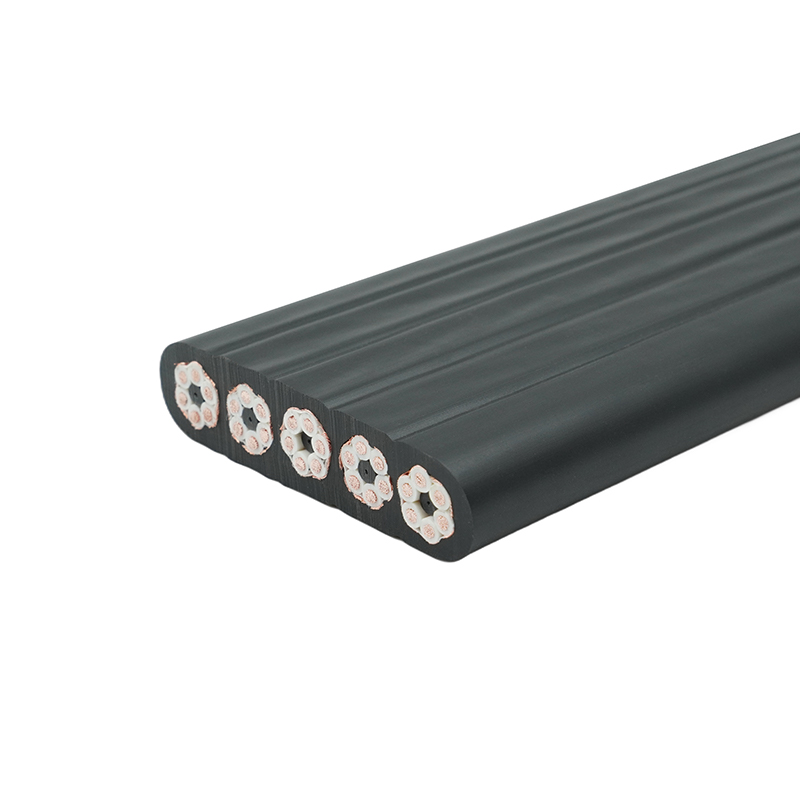 Compound Sheath Shielded Crane Traveling Flat Cable (YFFBP)Product Positioning: An exclusive cable for complex industrial electromagnetic environments, focusing on "anti-interference + space-saving". It adapts to precision sig...View Product →
Setting the Loop Geometry: Travel, Sag and Trolley Spacing
The loop has to be longer than the travel it serves, and the geometry has to leave room for the cable to fold without pinching. A simple working estimate is travel distance, plus twice the loop depth, plus about one and a half metres at each end for clamps and termination.
- Measure the total travel of the trolley along the runway, not just the crane bridge span.
- Fix the loop depth from the headroom you actually have, then confirm the cable can bend to that radius.
- Space trolleys roughly 1.5 to 2.5 m apart for flat cable; closer spacing reduces sag but adds track cost.
- Add clamping allowance at both ends and a short service loop at each junction box.
- Check the number of trolleys against track length, and make sure the stack does not collide with the end stop.
Too much sag lets cores migrate inside the sheath and eventually causes a kink at the trolley saddle. Too little sag loads the clamps and pulls the cable tight at full travel. A useful habit is to watch the loop through one complete machine cycle during commissioning and adjust the towing point until the cable folds without twisting.
Installation and Maintenance Practices
Festoon cables rarely fail from a single overload. They fail slowly, at a bend point or a clamp, over thousands of cycles. A short monthly walk-down catches almost all of it.
- Check the sheath along the whole loop for flat spots, gloss marks or fine cracks near the saddles.
- Push each trolley by hand and confirm it rolls freely; a sticking wheel is the first sign of a misaligned track.
- Check clamp torque and the condition of strain relief at both fixed ends.
- Look for twist in the loop, especially on round cable, and correct the towing point rather than forcing the cable.
- Keep oil, grit and metal swarf off the track, and clear any drip trays above the loop.
- Record loop depth after every adjustment, so a future shift is easy to spot.
Festoon, Conductor Bar or Cable Reel?
Festoon systems suit short and medium travel, typically up to around 60 m, and they are the cheapest way to run many cores at once. Conductor bars win on very long straight runways and on cranes with high duty cycles, but they need more civil work and separate protection. Cable reels are better for very long travel, vertical lifts and applications where a loop would be a hazard. Engineers comparing the two motorised options often find our notes on reeling cables versus drag chain cables helpful, because the same bending and tension logic applies to crane duty. Where a reel is the better answer, a waterproof dual-sheath construction keeps the outer jacket intact through winding and unwinding in wet yards.
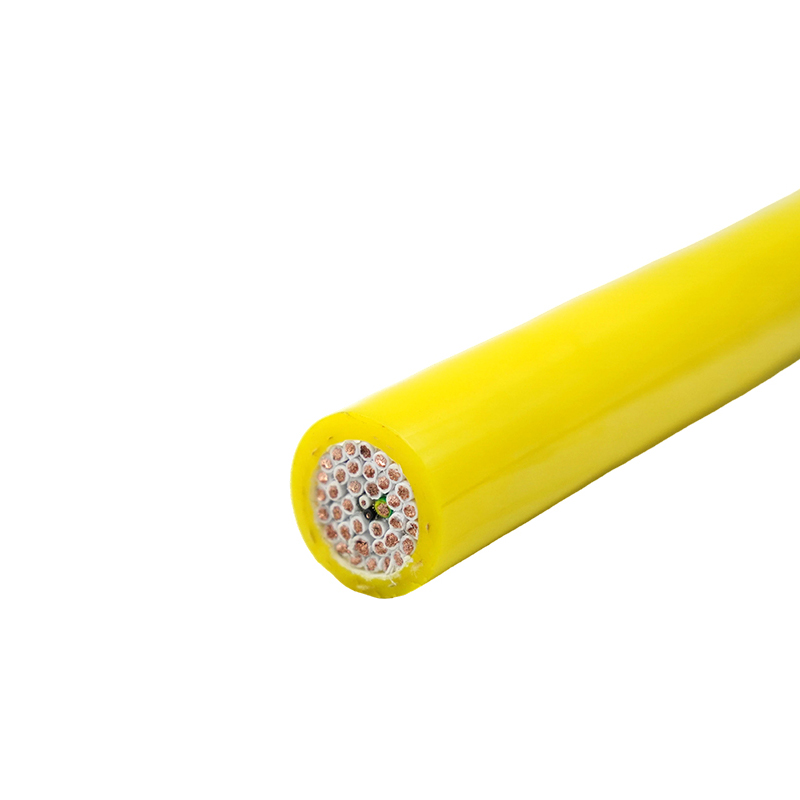 TPU Dual-Sheath Waterproof Crane Reeling Cable (Crane reel cable)Product Positioning: A dedicated power and control transmission cable designed for "high-frequency vertical/horizontal winding" working conditions of cranes (travellin...View Product →
Getting the Specification Right the First Time
Most festoon problems trace back to a specification written from a catalogue page rather than from the machine. Note the travel distance, the supply voltage, the total current, the number and type of control cores, the ambient temperature, the presence of oil or water, and whether drives or fieldbus signals share the loop. With those six facts, a cable construction can be matched to the duty instead of guessed at.
We design and build flat, shielded and steel-wire-reinforced travelling cables in our own plant, and we are happy to review a drawing or a photograph of an existing loop before you order. Send the travel data and we will come back with a construction, a bending recommendation and a trolley spacing suggestion that suits the crane you actually run.
If you would like to see the wider range first, start from our specialty cable range and narrow it down from there.