 EN
EN
 English
 русский
 Español
Reeling Cables vs. Drag Chain Cables: Key Differences & How to Choose
 2026.06.23
 Industry News
Content
- 1 Why Most Cable Comparisons Miss the Point
- 2 What Are Reeling Cables? Definition & Core Applications
- 3 Reeling Cables vs. Drag Chain Cables: A Side-by-Side Comparison
- 4 Key Performance Parameters for Reeling Cables
- 5 Material Matters: Choosing the Right Jacket (PVC vs. PUR vs. Rubber)
- 6 Application-Specific Selection Guide: Crane, Mining, Offshore & More
- 7 Decision Matrix: How to Match Your Application to the Right Reeling Cable
- 8 Beyond Standard: Custom Reeling Cables for Extreme Environments
- 9 Safety, Installation & Maintenance Best Practices
Why Most Cable Comparisons Miss the Point
A single reeling cable on a ship-to-shore container crane can cycle through 40,000 feet of winding and unwinding per year. When that cable fails unexpectedly, an hour of downtime at a major terminal can cost $50,000 or more. The real cost isn't the cable itself — it's the outage.
Engineers who maintain stackers, draglines, and offshore winches know this pressure. Yet many still treat reeling cables as "heavy-duty extension cords." That mindset leads to early jacket cracking, core breakage, and unplanned maintenance. Switching from a generic rubber cable to a properly specified reeling cable can double — sometimes triple — the service interval.
This guide cuts past the data sheets and gives you a structured way to evaluate, compare, and select reeling cables. We'll define what separates them from drag chain cables, map key performance parameters to real-world duty cycles, and provide a decision matrix that connects your operating conditions to cable construction.
What Are Reeling Cables? Definition & Core Applications
Reeling cables are flexible power, control, or combined cables designed specifically for continuous winding onto and off a drum or reel. Unlike stationary cables, they withstand repeated spooling, high tensile forces from cable weight and acceleration, and constant bending as layers stack under pressure. The defining movement is rotational: the cable wraps onto a cylindrical drum, often with multiple layers, while the machine travels or the boom slews.
These cables do not just "flex" — they spool. That distinction drives every material choice, from conductor stranding to jacket compound. In most installations, the cable feeds mobile equipment such as:
- Cranes: container gantry cranes, ship-to-shore cranes, overhead traveling cranes
- Mining: draglines, large hydraulic excavators, bucket-wheel reclaimers, stacker/reclaimers
- Port & material handling: rail-mounted gantry cranes, ship loaders/unloaders
- Offshore & marine: diving bell umbilicals, ROV launch systems, deck winches
In each case, the cable must deliver power reliably while absorbing mechanical stress that would destroy a standard flexible cable within weeks. A reeling cable for a stacker/reclaimer might need to tolerate 30+ reeling cycles per hour, each with variable line pull and a multi-layer drum configuration that creates crushing forces on the inner layers.
Reeling Cables vs. Drag Chain Cables: A Side-by-Side Comparison
"Can I use a drag chain cable on my winch drum?" is a question field technicians ask regularly. The short answer: rarely. The two cable families look similar on a spec sheet — both offer high flex cycles and abrasion-resistant jackets — but they serve fundamentally different motion profiles.
Drag chain cables are engineered for linear back-and-forth movement inside a cable carrier or track. They experience bending in one plane, with a free, unsupported radius. Reeling cables, by contrast, wrap onto a drum under tension, often forming multiple layers that crush lower wraps. Their bending is circular and combined with twist as the drum rotates.
The table below summarizes the key design differences.
| Parameter | Reeling Cables | Drag Chain Cables |
|---|---|---|
| Primary motion | Rotational winding onto drum | Linear reciprocating in carrier |
| Bend radius (min) | 12-15 x cable O.D. (typical) | 7.5-10 x cable O.D. |
| Tensile element | Integrated steel or aramid central strength member; layer-resistant design | Often none; or anti-torsion fillers |
| Jacket focus | High tear resistance, notch propagation resistance, low friction for layer-on-layer slip | Low-friction, low-adhesion jacket for chain movement |
| Flex cycle rating | 1–5 million binge cycles (single-layer); 200,000+ multi-layer | 5–10+ million bending cycles (linear) |
That doesn't mean one is superior. It means using a drag chain cable on a reel shortens its life dramatically, often by a factor of ten. For applications that demand both linear and reeling capability, a cable built specifically for combined motion is needed — and that's where a well-specified reeling cable becomes non-negotiable.
Key Performance Parameters for Reeling Cables
Selecting a reeling cable without understanding its performance thresholds is like setting a crane's SWL based on a guess. The following five parameters determine whether your cable survives 6 months or 6 years. Insist on test data, not just catalogue claims.
1. Bending Cycles and Multi-Layer Endurance
Look for a rated service life under defined spooling conditions — ideally per VDE 0472 or IEC 60227 test protocols. Single-layer reeling cables should achieve at least 1 million cycles. For multi-layer applications, ask for crush-resistance data because inner layers experience compressive loads exceeding 10 N/mm² on large drums.
2. Tensile Strength and Central Strength Members
Reeling cables must carry their own suspended weight plus dynamic forces. A central fiber (aramid) or steel rope core is standard. Choose a cable whose maximum permissible tensile load exceeds 15 N/mm² of total conductor cross-section, with strain relief elements anchored properly in the cable gland.
3. Jacket Abrasion and Tear Resistance
As layers slide against each other during winding and unwinding, the jacket must resist abrasion and tearing. Taber abrasion values (ASTM D4060) below 150 mg weight loss per 1000 cycles at a 1000 g load are typical for high-performance PUR compounds. Tear strength above 50 N/mm helps prevent small nicks from turning into full jacket rupture.
4. Temperature Range – Static and Dynamic
Reels on ship cranes exposed to arctic cold or desert heat demand materials that remain flexible. PUR-based reeling cables often cover -40 °C to +90 °C dynamic, while silicone jackets push the upper limit past +180 °C. Always specify the dynamic temperature range, not just static.
5. Torsional Stability
Helical wrapping around a drum induces twist. Cables with specially cabled conductor layers and anti-twist fillers can tolerate ±30° per meter of lay length without conductor breakage. Verify torsional performance through a twist test (EN 50396 or equivalent).
Material Matters: Choosing the Right Jacket (PVC vs. PUR vs. Rubber)
The outer jacket is the cable's first line of defense. Each material offers a distinct balance of chemical resistance, low-temperature flexibility, and abrasion tolerance. The table below gives a comparative view.
| Property | PVC | PUR | Rubber (EPR/CR) |
|---|---|---|---|
| Oil & fuel resistance | Moderate | Excellent | Good |
| Hydrolysis resistance | Good | Excellent | Moderate |
| Abrasion resistance | Moderate | Very high | High |
| Low-temp flexibility | Limited (-25 °C) | -40 °C and below | -30 °C to -40 °C |
| Typical max temp (dynamic) | +70 °C | +80 °C to +90 °C | +90 °C (special compounds) |
| Best for | Indoor/light reeling | Ports, offshore, high-flex | Mines, hot metal areas |
For most severe outdoor applications — port cranes, ship loaders — PUR is the default choice because it withstands salt spray, UV, and constant flexing without softening. Rubber compounds still dominate in mining where hot slag and metal splashes require high heat tolerance, even if that means sacrificing some cold flexibility.
Application-Specific Selection Guide: Crane, Mining, Offshore & More
Below we map four common heavy-duty environments to the cable construction features that make the difference between routine operation and premature failure. Use these as a starting point for your technical specification.
| Application | Typical Reeling Speed | Key Stressors | Recommended Cable Features |
|---|---|---|---|
| Container crane (STS) | 60–180 m/min | High winds, salt spray, rapid layer-on-layer spooling | PUR jacket, steel-core strength member, individually shielded control pairs, minimum bend radius 12.5 x O.D. |
| Stacker/reclaimer (mining) | 20–40 m/min | Cuttings, mud, extreme temperature swings, multi-layer crushing | Heavy-duty rubber jacket (EPR), with high fill-factor conductor stranding; dense braid shield for EMI from nearby motors |
| Offshore pedestal crane | 30–90 m/min | Continuous sea spray, low temperature, dynamic twist | PUR or specialty low-temp rubber, aramid strength member, torsionally stable core construction, halogen-free to meet SOLAS |
| Mining shovel & dragline | 10–30 m/min | Severe abrasion, rock impact, oil mud, high pull forces | Extra-thick chloroprene rubber jacket, two-layer reinforcement (braid + steel wire), strain relief rated for 5x safe working load |
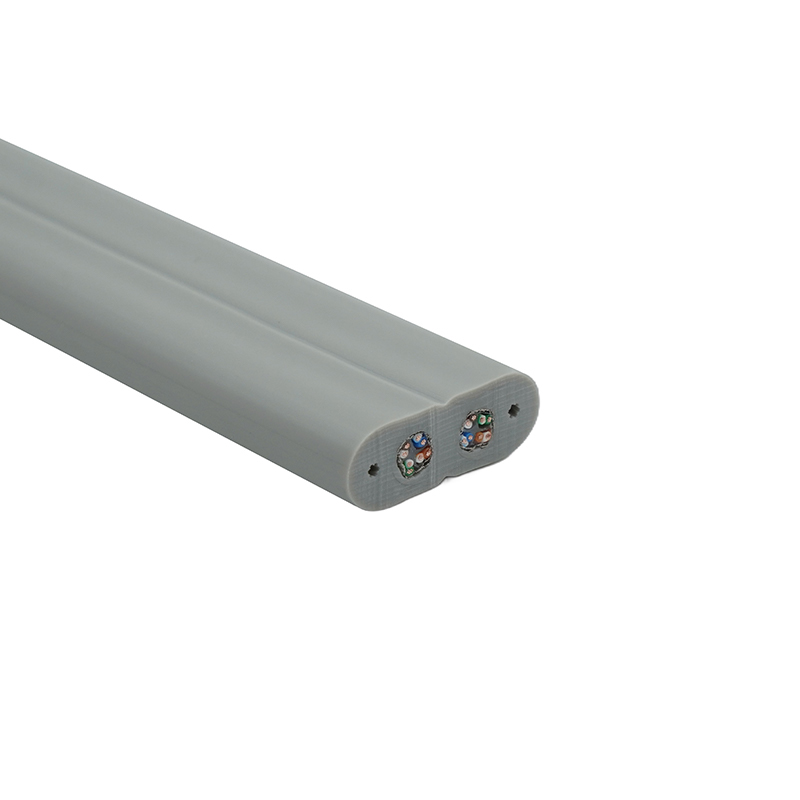
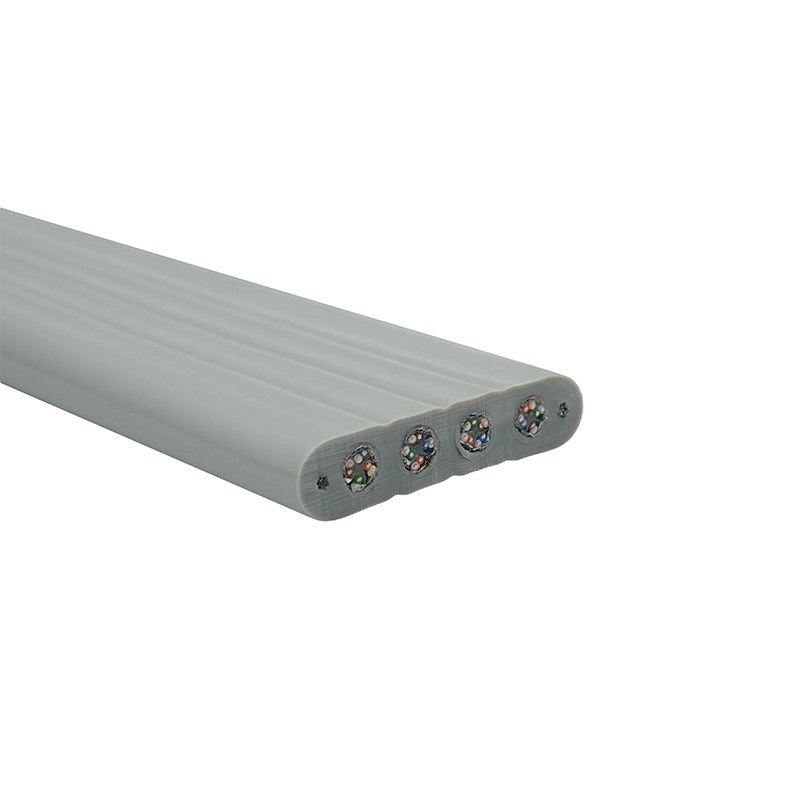
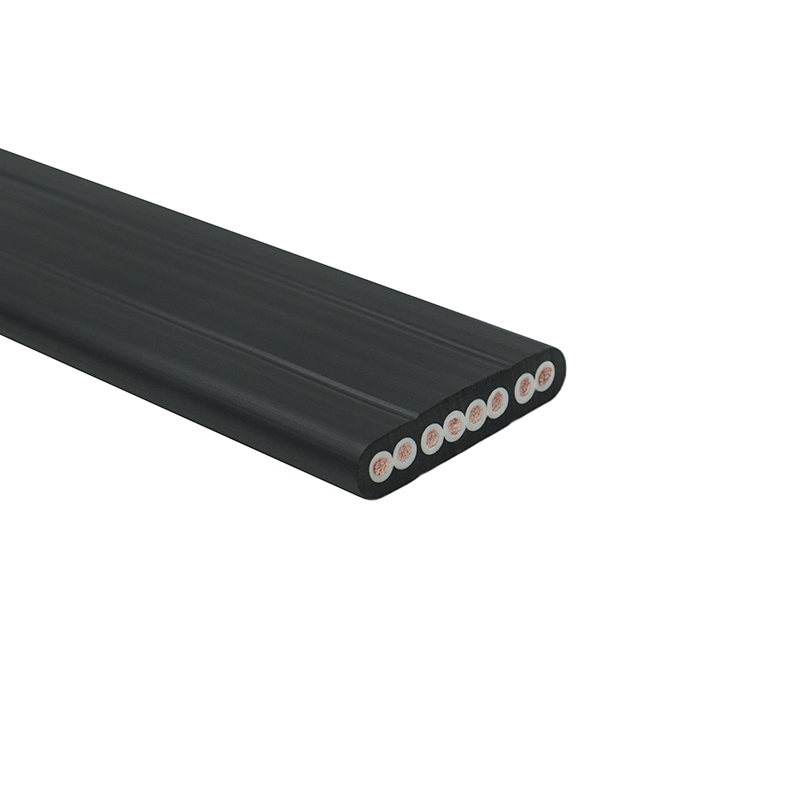
For cranes operating in constrained headroom, a flat cable can sometimes complement a vertical reeling system by reducing stack height and improving heat dissipation. But the flat design must be explicitly rated for reeling with multi-layer winding, otherwise drum pressures will crush the core prematurely.
Decision Matrix: How to Match Your Application to the Right Reeling Cable
When multiple environmental factors compete, a structured matrix simplifies the choice. The matrix below clusters four condition categories and suggests priority levels (High / Medium / Low) for cable attributes that must be emphasized.
| Operating Condition | Jacket Abrasion Resistance | Tensile Strength | High-Flex Conductor Design | Shielding/EMC | Certification Level |
|---|---|---|---|---|---|
| High mechanical stress (heavy reeling, multi-layer) | High | High | High | Medium | High (e.g., CE, UL) |
| Extreme temperatures (<-30 °C or >80 °C) | Medium | Medium | Low | Low | High (material certs) |
| Chemical/oil exposure | High (oil-resistant jacket) | Low | Low | Medium | Medium |
| High bending frequency (>30 cycles/h) | Medium | Low | High | Low | Low (performance certs) |
This matrix does not replace a full engineering review, but it quickly flags where investment should go. For example, a mining shovel with medium bending frequency but severe abrasion and high pull forces: the matrix indicates high emphasis on tensile strength and abrasion resistance, with moderate shielding and certification needs.
Beyond Standard: Custom Reeling Cables for Extreme Environments
Not every drum fits a catalogue cable. When you need combined power, signal, and Ethernet in one jacket — or a cable that floats — standard product lines fall short. Custom reeling cables address these gaps through tailored construction without starting from zero.
Common customizations we engineer include:
- Integrated data pairs: CAT6A or fiber optic elements twisted with power conductors, all within a torsionally stable overall lay.
- Dual-jacket designs: A hard inner layer for crush resistance and a softer, low-friction outer layer for smooth spooling.
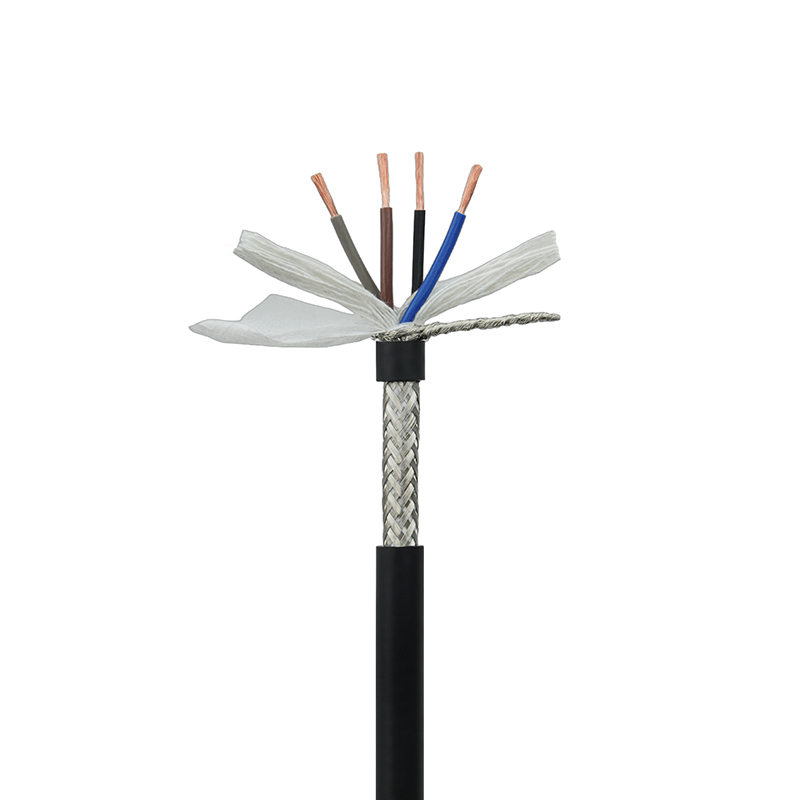
- Drain wire + high-coverage braid for EMC-critical applications near VFD drives.
- Floatation modifications: Produced by incorporating buoyant filler compounds and a closed-cell fluoropolymer outer layer, making the cable positively buoyant — ideal for ROV launch and recovery systems.
- High-temp compounds: Silicone or fluoropolymer jackets that maintain flexibility at +180 °C continuous ambient, validated through heat-soak bend tests.
One proven example: an underwater inspection ROV operating at 200-meter depth required a neutrally buoyant tether that could wrap onto a small-diameter winch drum. The custom solution combined a floating cable core with a water-blocking aramid layer and a thin, abrasion-resistant PUR jacket — giving the vehicle full freedom while the tether survived over 10,000 reeling cycles without twist-induced kinking.
Custom doesn't always mean long lead times. Many engineered constructions use proven sub-components that only need a modified cabling sequence or new jacket extrusion.
Safety, Installation & Maintenance Best Practices
Even the best cable will fail early if installed incorrectly. Reeling systems impose high mechanical and electrical demands, and many failures trace back to avoidable installation errors.
Key installation rules:
- Never exceed the minimum bending radius specified for the cable, especially at the drum entry point where the combination of bending and tension is highest.
- Anchor the strain relief element properly in the termination gland — the cable must transfer pull forces to the drum structure, not to the conductor connections.
- Ensure the cable winding tension remains consistent; slack windings cause crossover and crushing, while over-tensioning accelerates jacket wear.
- Use under-bend rollers or sheaves that match the cable O.D. to spread contact pressure.
As per AS/NZS 3000 and international guidance, create a simple inspection checklist:
- Daily visual check: Look for jacket cuts, bulges, or uneven spooling pattern.
- Weekly: Check gland tightness and cable entry sealing for water ingress.
- Monthly: Measure insulation resistance (IR) between all conductors and ground to detect moisture penetration; a drop below 1 MΩ per kV indicates potential trouble.
- Quarterly: Inspect a short sample of the cable near terminations for conductor strand breakage using a pull-test or microscopic inspection.
- Annually: Compare the measured outer diameter against the original specification; swelling beyond 5% often indicates jacket degradation or internal moisture.
Maintaining a disciplined inspection program doesn't eliminate the need for correct initial selection, but it almost always extends service life by 20–30% and prevents unplanned production stops.