 EN
 English
 русский
 Español
Motor Cables: Types, Sizing, Shielding and Installation Guide for Engineers
 2026.10.26
 Industry News
Content
- 1 What Makes a Motor Cable Different
- 2 Matching the Cable to the Motor Duty
- 3 Drive Duty: What a VFD Motor Cable Has to Handle
- 4 Continuous Motion: Servo, Drag Chain and Reeling Duty
- 5 Getting the Size and the Current Right
- 6 Insulation, Jacket and the Working Environment
- 7 Installation Details That Decide Cable Life
- 8 Certification and Regional Expectations
- 9 A Short Checklist Before You Order
Ask ten engineers to describe a motor cable and you will hear four or five different answers. One will picture the heavy three-core feeder running from a starter to a pump. Another thinks of the shielded drive cable between a variable frequency drive and a motor terminal box. A third points at the servo lead inside a machining centre, and a fourth mentions the small brake and encoder cables that never carry motor current at all. Every one of those is a motor cable, and each one tends to fail for a completely different reason.
Over the years we have built a lot of these cables for machine builders, integrators and maintenance teams, and the pattern is fairly consistent. When a motor cable fails early, it is almost never because the copper was bad. It is because one of four things was mismatched: current capacity, shielding, flexibility or the working environment. Get those four right and the rest is detail.
What Makes a Motor Cable Different
A motor cable carries current under conditions that ordinary building wire never sees. It is usually the cable with the highest continuous load in the cabinet, it often sits at the end of a long run with limited ventilation, and in modern installations it is fed by a switching device rather than a clean sinusoidal supply. On top of that, the cable frequently has to move, bend, twist or hang in free air.
The practical consequences are predictable:
- Thermal load — continuous current plus harmonic content heats the conductor and, more importantly, the insulation around it.
- Switching stress — pulse width modulated output produces fast voltage edges, reflected wave overvoltage on long runs and common-mode current on the shield.
- Mechanical duty — continuous flexing in a drag chain, torsion on a robot axis, or repeated spooling on a crane drum.
- Environment — oil mist, coolant, water, UV, low temperature or a hot equipment enclosure.
Each of those loads points to a different construction choice, which is why a single cable type is rarely the right answer for a whole plant.
Matching the Cable to the Motor Duty
The quickest way to narrow the field is to start from the application rather than the part number. The table below shows the pairing we see most often in real projects, together with the property that usually decides whether the cable lasts its full service life.
| Motor duty | Typical construction | Deciding factor |
|---|---|---|
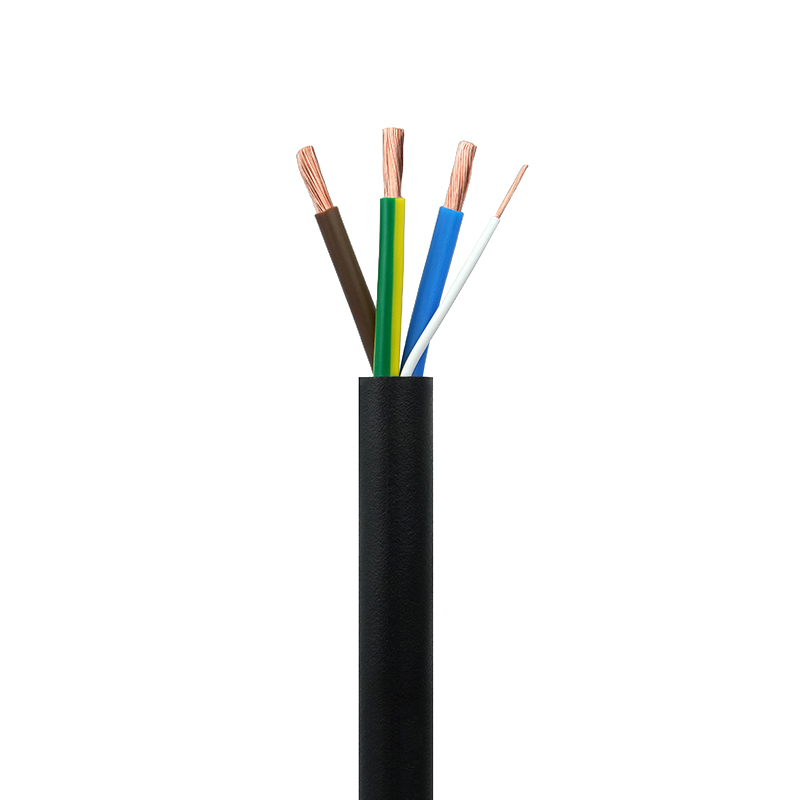
| Fixed-speed motor, short feeder | 3-core or 4-core XLPE or PVC power cable, unshielded | Ampacity and voltage drop |
| Motor fed by a VFD or inverter | Symmetrical 3-core plus 3 earth, overall shield, XLPE, 0.6/1 kV | Shield coverage and cable capacitance |
| Servo or spindle axis | 4-core shielded servo cable, fine-strand copper, PUR jacket | Flex and torsion life |
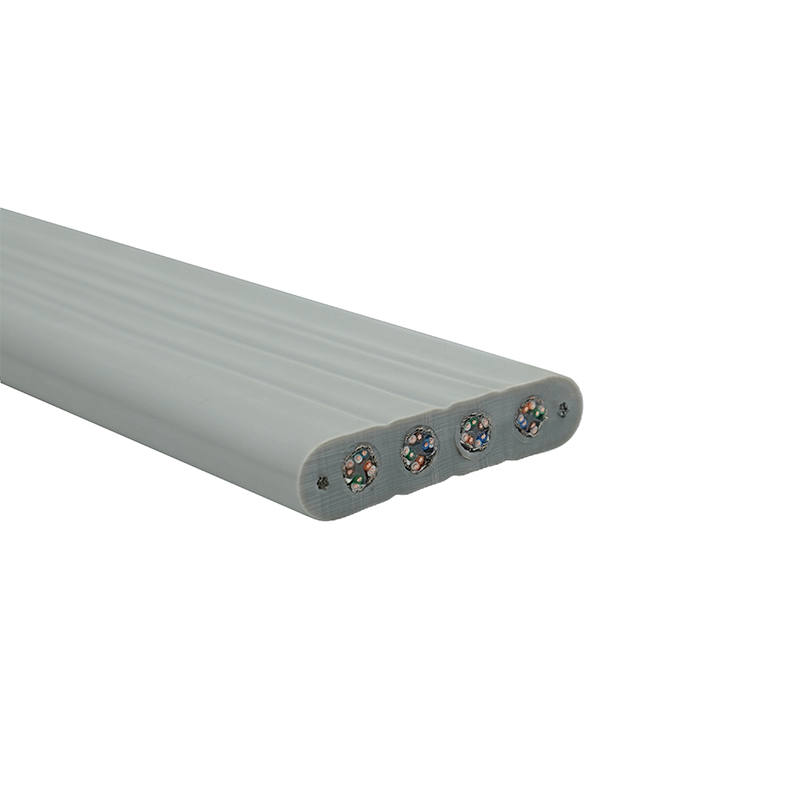
| Crane, hoist or trolley travel | Flat traveling cable, often with steel carrier wires | Tensile load and bend radius |
| Pump, submersible or washdown area | Rubber or PUR sheathed, water-resistant | Ingress protection and jacket toughness |
Two of these rows deserve more attention than they usually get: drive duty and continuous-motion duty. Those are the two situations where a "normal" power cable quietly becomes the weakest item on the machine.
Drive Duty: What a VFD Motor Cable Has to Handle
An inverter output is not a sine wave. The fast switching edges travel down the cable, and if the run is long relative to the rise time, the pulse reflects at the motor terminals and can roughly double the peak voltage. That is why drive-rated motor cable is specified at a higher voltage class than the motor nameplate suggests, and why the insulation wall and the conductor-to-conductor spacing matter more than the cross-section alone.
The shield has a second job. Capacitive current couples from the conductors to the screen, and that current has to return to the drive through a low-impedance path. A drain wire twisted out at one end is not that path. A proper 360 degree termination to the gland or EMC bracket is, and it is the single most common installation mistake we are asked to help fix. If you want to go deeper into the electrical background, our engineers have written a separate guide on VFD cable requirements and shielded construction.
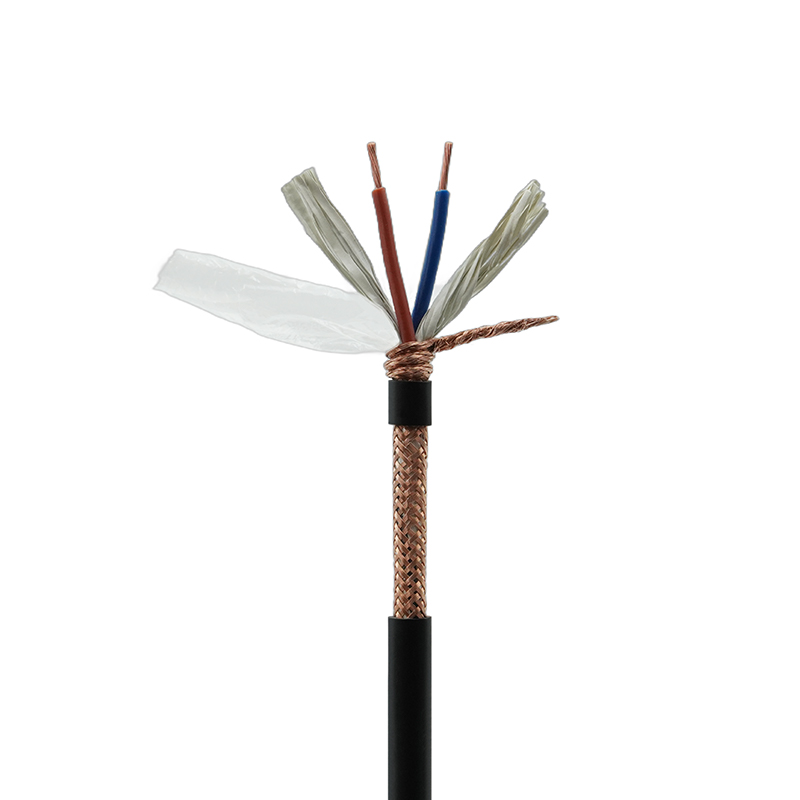
 XLPE Insulated Shielded Flexible VFD Cable BPYJVRPFlexible high-voltage cable with XLPE insulation, PVC sheath and copper braid shielding, suited to industrial and new energy equipment needing power transmission and interference protection.View Product →
In our own range, the drive cable we build combines XLPE insulation, a symmetrical three-core plus three-earth layout and a copper braid shield. Symmetry matters because it keeps the phase-to-earth capacitance balanced, which reduces the bearing currents that quietly destroy motors on long feeder runs.
Continuous Motion: Servo, Drag Chain and Reeling Duty
Once a motor cable has to move, the conductor stranding and the jacket compound become the limiting factors. A coarse stranded conductor will work perfectly well in a static tray and will break within months in a drag chain at two metres per second. For that duty we use very fine copper stranding, a jacket compound chosen for abrasion rather than for looks, and a construction that keeps the cores from rubbing against each other as the cable rolls.
Three motion patterns need to be separated in the specification, because a cable optimised for one will underperform in another:
- Linear flexing in a cable carrier, where bend radius, travel length and acceleration decide the expected cycle life.
- Torsion on a robot wrist or a rotating axis, where the lay length of the stranding has to be designed for twisting rather than bending.
- Spooling and festooning on cranes and reeling drums, where the cable sees tension, stacking pressure and sometimes a harsh outdoor climate.
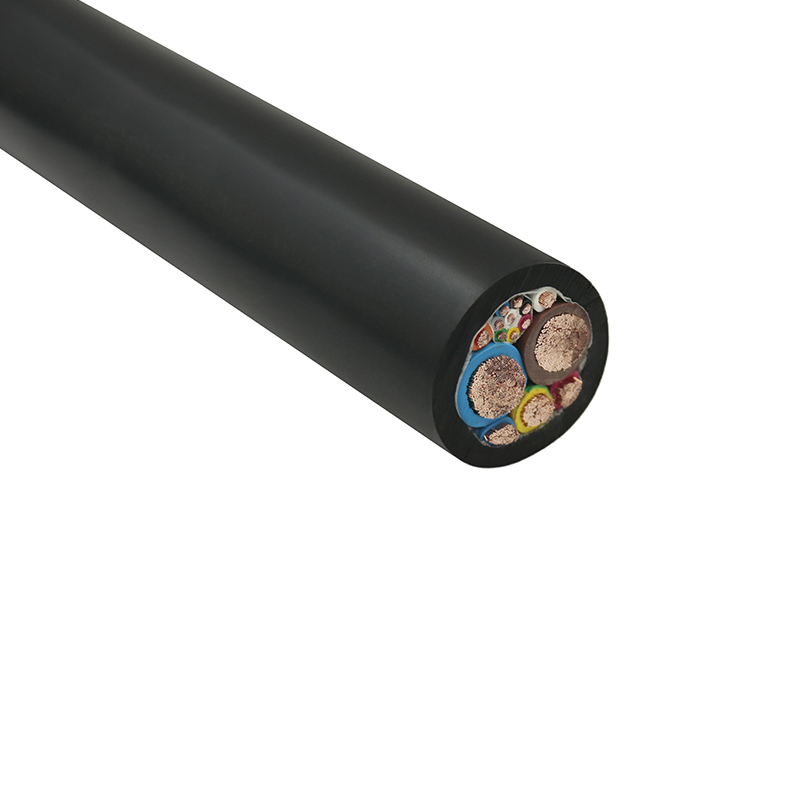
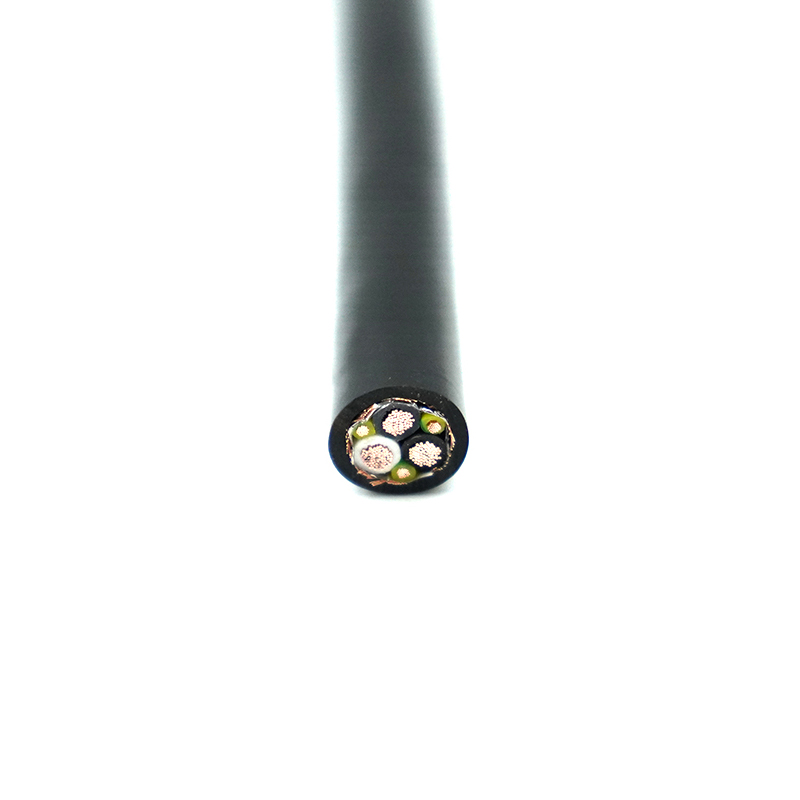
 High-Flex Shielded Servo Drag Chain CableShielded high-flex servo cable for drag-chain use, connecting servo motors and drives where a mechanically stable assembly can reduce intermittent faults.View Product →
For servo axes we normally supply a shielded, high-flex construction with matched power and feedback cores, so that the drive and the encoder share a single mechanically stable assembly. It costs a little more than two separate cables, and it removes a whole category of intermittent faults from the machine.
Getting the Size and the Current Right
Motor cable sizing is not only a matter of reading a current value off a chart. A sound selection answers four questions before a cross-section is chosen.
- What is the actual running current? Full load current from the nameplate is the starting point, but the installation standard usually asks for a margin — around 125 percent of full load current for continuous duty is a common benchmark.
- How will the cable be installed? Ambient temperature, grouping with other loaded cables, enclosure temperature, buried depth and free air all change the allowable current. A cable that is correct in open air can be overloaded inside a duct bank.
- How long is the run? Voltage drop is the quiet killer of pump and fan performance. Keeping the drop within a few percent at full load protects starting torque and efficiency far more effectively than an oversized motor.
- Are there harmonics or a duty cycle? Inverter output adds harmonic losses that a standard table does not reflect, and hoists, presses and mixers rarely draw a steady current. Both argue for a little extra copper.
Short circuit withstand and earth conductor sizing should always be checked at the same time. They are protection requirements rather than performance ones, but they are the requirements a safety inspector will ask about first.
Insulation, Jacket and the Working Environment
Two materials decisions sit behind most of the reliability differences we see in the field. The first is insulation. PVC is economical and adequate for many fixed installations, XLPE handles higher conductor temperatures and is the natural partner for drive duty, and silicone or FEP comes into play when ambient temperatures climb well beyond what a standard compound tolerates. The second is the jacket. PUR gives excellent abrasion and oil resistance for moving applications, rubber compounds stay flexible in cold and outdoor conditions, and a plain PVC jacket is often the right answer indoors and away from chemicals.
It helps to write the environment down honestly at the specification stage: oil mist from a machining centre, coolant splash, washdown hoses, salt air, UV on an outdoor gantry, or the radiant heat from a nearby furnace. Each of those is a jacket question, and each has a cost-effective answer if it is raised early instead of after the first failure.
Installation Details That Decide Cable Life
Even a well-chosen motor cable can be ruined in an afternoon by the way it is installed. The details below are the ones we raise most often with customers during commissioning.
- Respect the minimum bend radius in both the static and the moving state, and remember that the moving figure is much larger.
- Terminate the shield around its full circumference, at both ends where EMC performance matters, using a proper gland or bracket rather than a pigtail.
- Keep motor and drive cables physically separated from encoder, bus and analogue signal cables, and cross at right angles where a crossing is unavoidable.
- Provide strain relief so that pulling force is taken by the jacket, never by the conductor strands or the terminal screws.
- Follow the carrier manufacturer's guidance on cable placement, clearance and the neutral axis of the bend.
- Seal the motor terminal box properly in humid or washdown areas, so moisture does not travel inside the cable by capillary action.
Certification and Regional Expectations
Motor cables cross borders more often than finished machines do. A panel built for the North American market normally needs UL recognised or listed conductors, equipment sold in Europe needs CE marking and often harmonised designations, and projects in China require CCC. We hold CCC, UL, ISO 9001 and CE certification precisely because our customers ship equipment to more than one region, and re-qualifying a cable late in a project is expensive.
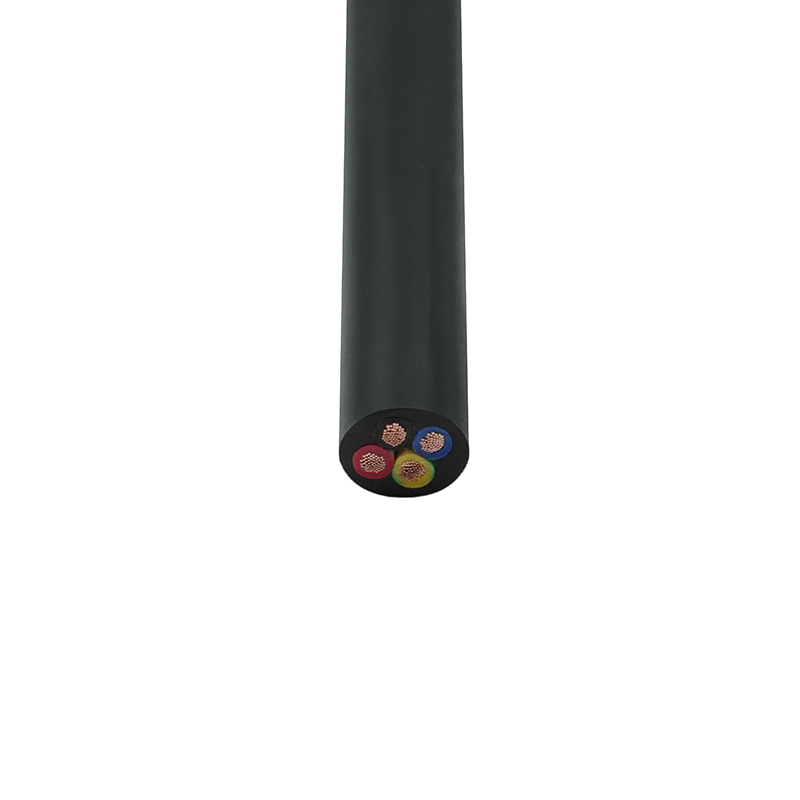 UL2586 North American Equipment Power WireUL-certified equipment wiring cable for machine tools and high-temperature, oil-resistant use, combining high-voltage power and multi-core integration in one durable construction.View Product →
It is worth matching the cable schedule to the target market at the quoting stage rather than at the drawing release stage. If a dual-certified construction can serve both markets, one part number in the bill of materials is much easier to manage than two. You can read more about how we work and how our production is organised on our company profile page.
A Short Checklist Before You Order
Whenever a customer is unsure which motor cable to specify, we work through the same short list. It takes a few minutes and usually settles the question.
- Motor type, rated power, full load current and supply voltage.
- Drive or direct-on-line starting, and the length of the feeder.
- Static or moving installation — and if moving, the bend radius, travel distance and speed.
- Ambient temperature, oil, water, UV and any washdown chemicals.
- Required approvals for the destination market.
- Core count, including earth, brake, thermal protection or feedback pairs.
- Preferred jacket material and colour, plus any marking or reel-length requirements.
Motor cables are rarely the most interesting component on a machine, but they are one of the few that touch almost every failure mode at once: heat, electricity, movement and weather. Treating the selection as an engineering decision rather than a purchasing one is the simplest way to remove unplanned downtime from a project.
If you are working through a specification and something does not quite fit the standard catalogue, tell us the duty and the environment. Special and customised motor cable designs are what our workshop does every day, and a short conversation at the drawing stage is almost always cheaper than a replacement reel later.