 EN
EN
 English
 русский
 Español
Flat Festoon Cable: A Practical Selection and Buying Guide for Cranes and Hoists
 2026.08.28
 Industry News
Content
An overhead crane at full travel asks one hard thing of its power cable: survive thousands of bend-and-hang cycles per shift without kinking, twisting, or pulling loose from its clamps. A flat festoon cable exists for exactly this duty. It is a flat-profile multicore cable built for festoon systems, where loops of cable ride on trolleys along a track and stack or spread out as the crane, hoist, or carrier moves.
The flat cross-section is the whole point. Flat festoon cable folds into tidy, overlapping loops between trolleys instead of the bulky, crossing coils that round cable tends to form, and it spreads bending stress across a wide face rather than concentrating it at a few points. That is why it has become the default for crane runway electrification, monorail hoists, and transfer cars. This guide explains how the system works, where flat beats round, and what to check before you order.
How a Festoon System Moves Cable
A festoon system electrifies moving equipment over a fixed path without a cable drum. A track is mounted along the runway, and a series of trolleys runs along it. One end of the cable is anchored at a feed point; from there the cable zigzags between adjacent trolleys, hanging in U-shaped loops. A tow trolley connects to the moving equipment, so the whole string is pulled along the track as the load travels.
As the equipment moves away from the feed point, the loops pull out and stretch toward straight. When it returns, the loops collapse and stack. The cable therefore alternates between hanging freely and being drawn nearly flat on every pass, for years.
The flat shape earns its place here for three reasons. Flat loops stack neatly on top of one another, so trolleys can sit closer together and the track can be shorter for a given travel distance. The wide face gives clamps a stable gripping surface, which keeps the cable from rotating in its clamps, the leading cause of twist failures. And bending is shared across the flat face, lowering peak strain on any single core.
Flat vs. Round Festoon Cable
Round cable is not wrong in festoon service — it simply suits different geometry. The practical differences come down to how each shape stacks, bends, and resists twist.
| Attribute | Flat Festoon Cable | Round Festoon Cable |
|---|---|---|
| Loop stacking | Folds into flat, overlapping loops; trolleys can sit close together | Bulkier coils that can cross; needs wider trolley spacing |
| Bend stress | Spread across the wide flat face, lowering peak strain per core | Concentrated around the circumference at local points |
| Twist behavior | Resists rotation and stays flat inside clamps | Prone to corkscrewing when clamped over time |
| Space and weight | Thinner profile, often lighter per loop | Larger diameter for the same conductor count |
| Best fit | Crane runways, monorail hoists, transfer cars at medium speeds | Long-travel or high-speed runs using motorized reeling |
For very long travel distances or high travel speeds, motorized cable reeling usually takes over, and round reeling cables dominate that field. Our comparison of reeling cables and drag chain cables explains where each cable management method fits and why the cable construction changes with it.
Construction Details That Decide Service Life
Two flat festoon cables can look identical and still behave very differently over years of travel. Three construction choices do most of the work.
Conductors and Core Layout
Fine-stranded flexible copper is standard, because solid or coarse-stranded cores work-harden and crack under repeated bending. The cores sit side by side in a flat formation, and it pays to plan the mix up front: power cores, control cores, and a ground conductor can share one flat cable, which simplifies clamping and keeps the festoon lighter than running separate cables would.
Sheath Compounds
PVC sheaths cover most general indoor applications and keep cost down. Rubber and elastomer compounds extend service into oil mist, abrasion, outdoor UV, and low-temperature yards. Polyurethane suits severe abrasion and oil exposure. Matching the compound to the environment matters more than most buyers expect — a sheath that hardens in cold weather turns a flexible cable into a stiff one within a season.
Tension Members and Shields
Because clamps hold the sheath while the cable hangs between trolleys, many festoon flat cables integrate a steel wire or high-strength textile member that carries the tensile load so the copper cores do not. Leave it out on long trolley spacing and the cores gradually stretch. Where the same flat cable carries control signals near variable-frequency drives, a braided shield keeps electrical noise out of the signal cores.
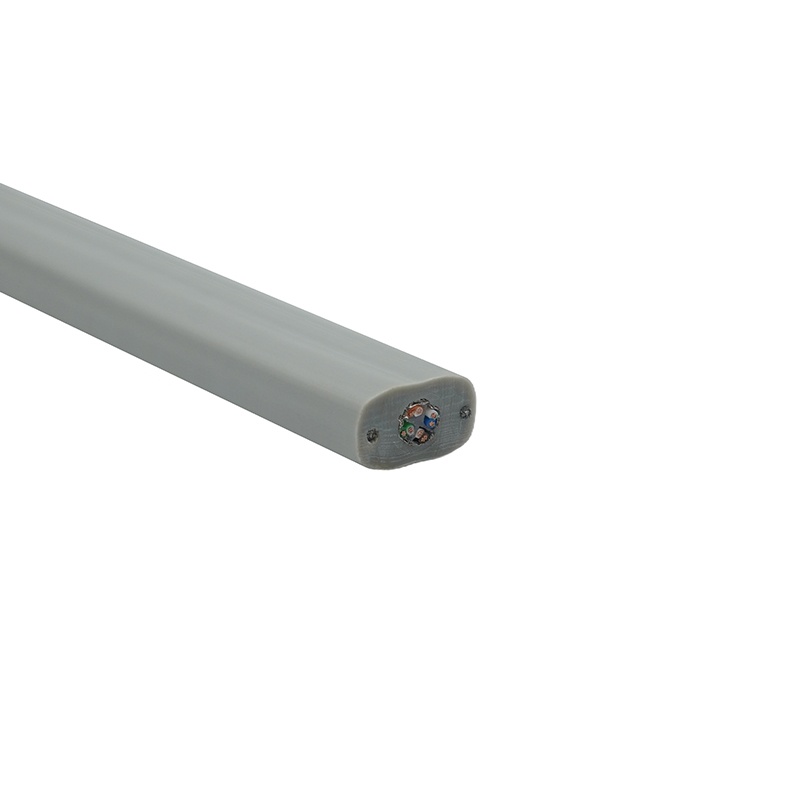
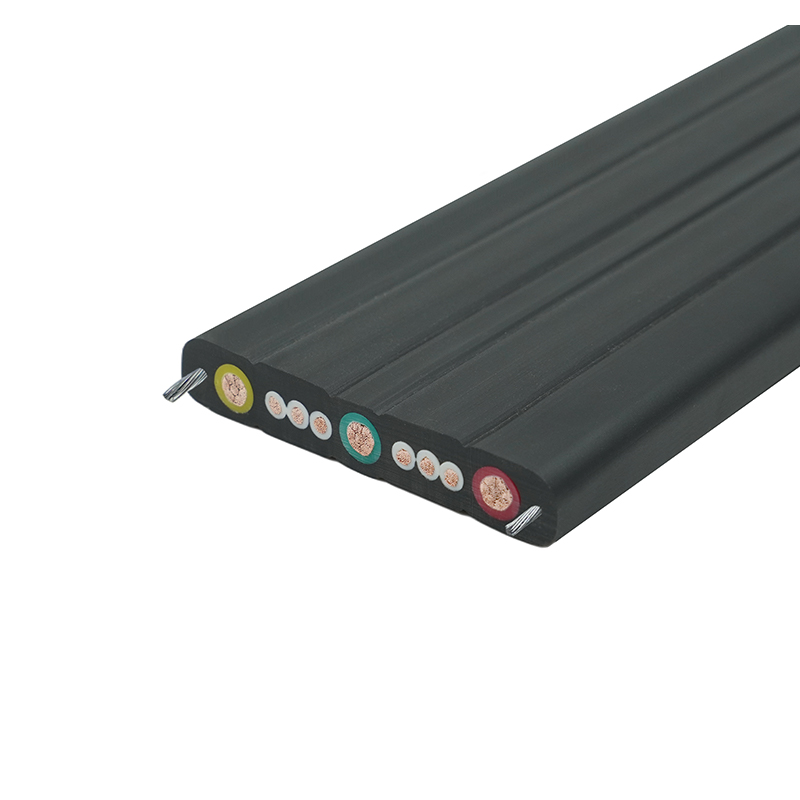 YFFBG Compound Sheath Crane Flat Cable with Steel Wire ReinforcementThis steel-wire-reinforced flat cable carries tensile loads over long suspension spans, so copper cores avoid stretching between festoon trolleys. It suits outdoor crane and conveyor power and control lines rated up to 450/750V AC.View Product →
Selecting a Flat Festoon Cable: A Practical Checklist
Work through the following items in order and most specification mistakes disappear before the quotation stage:
- Circuits and voltage. Confirm whether the cable carries power only, power plus control, or power, control, and signal, then match the rated voltage — 300/500V suits many control-light setups, while 450/750V is the norm for main power feeds.
- Conductor size. Size each core for full-load current and check voltage drop over the full travel distance, not just the loop length.
- Motion profile. Record travel distance, travel speed, and cycles per hour; together these define how aggressive the bending duty is.
- Environment. Note indoor or outdoor exposure, temperature range, oil, moisture, and UV, because these decide the sheath compound.
- Loop geometry. Compare the manufacturer's minimum bending radius with your planned loop depth and trolley spacing.
- Tension member. Wider trolley spacing and heavier cables call for an integrated steel wire or textile strength member.
- Shielding. Add a shield when VFD-driven power circuits and signal cores share the cable.
- Certification. Match the mark to the destination market — CE for Europe, UL for North America, CCC for China.
As a reference point, a CE-certified flat cable rated 450/750V is a common baseline for crane and hoist power in European-style systems, and it is one of the standard constructions in our crane flat cable range.
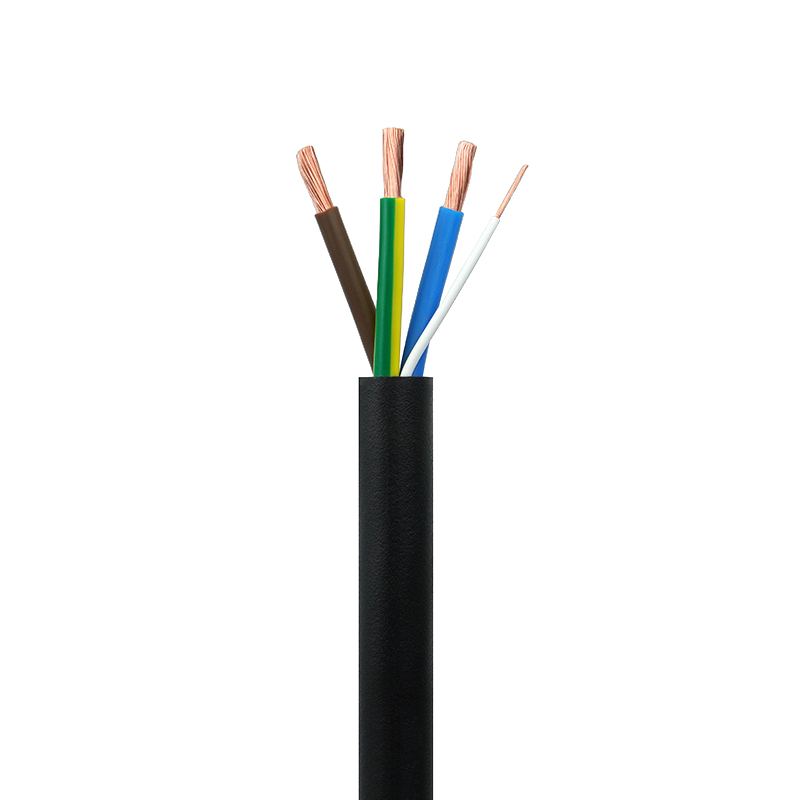
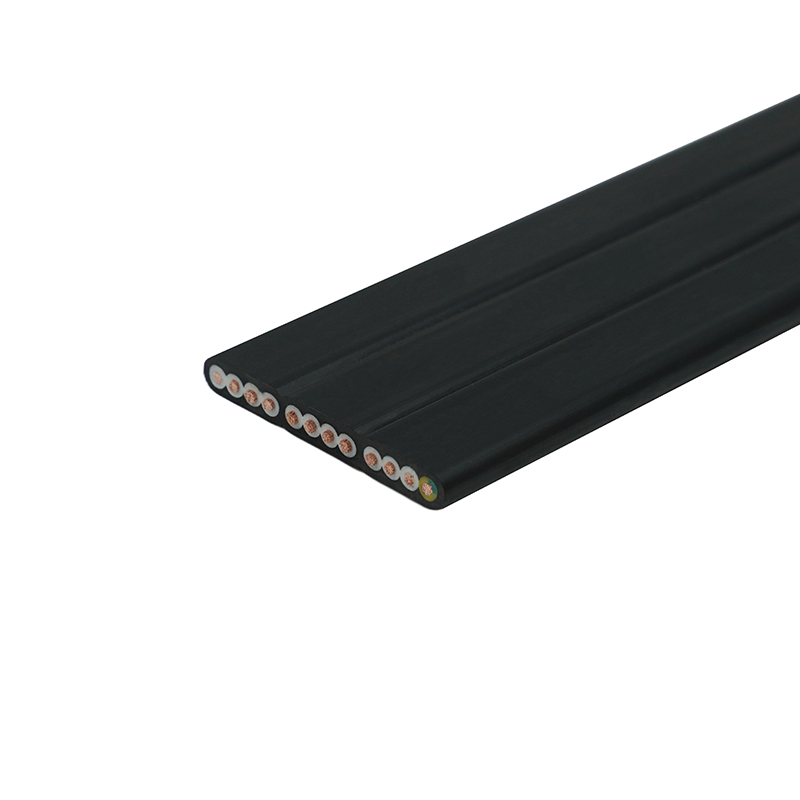 H07VVH6-F CE Certified Flat Cable Rated 450/750VServing as a baseline for European-style crane and hoist power, this CE-certified 450/750V flat cable suits festoon systems on runways, monorail hoists, and other equipment traveling over fixed paths where space is tight.View Product →
Where Flat Festoon Cable Is Used
Crane runways and monorail hoists are the classic installations, but the same festoon logic appears wherever equipment travels back and forth over a fixed path: transfer cars on rails, conveyor shuttle and take-up sections, gantry crane leg power, car wash equipment, and stage rigging. In tight spaces the flat profile is often the only format that keeps the loops manageable.
The flat format also suits hybrid designs. One flat cable can carry three-phase power, control cores, and even data pairs side by side — the same approach used in elevator traveling cables that combine power cores with Cat6 patch cores under a single sheath. On cranes with variable-frequency travel drives, a shielded flat construction keeps drive noise from disturbing control and feedback signals.
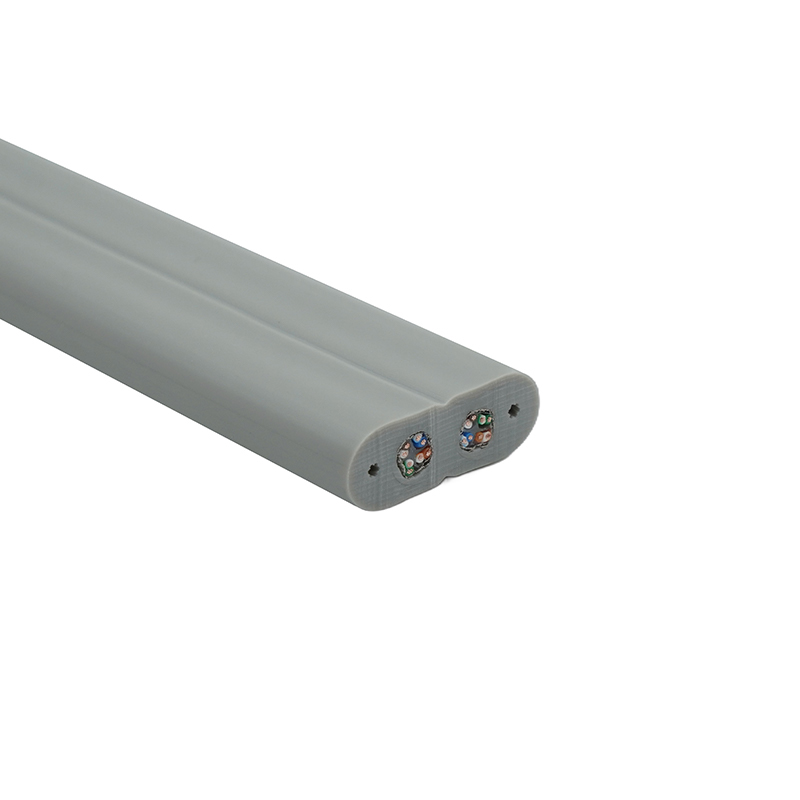
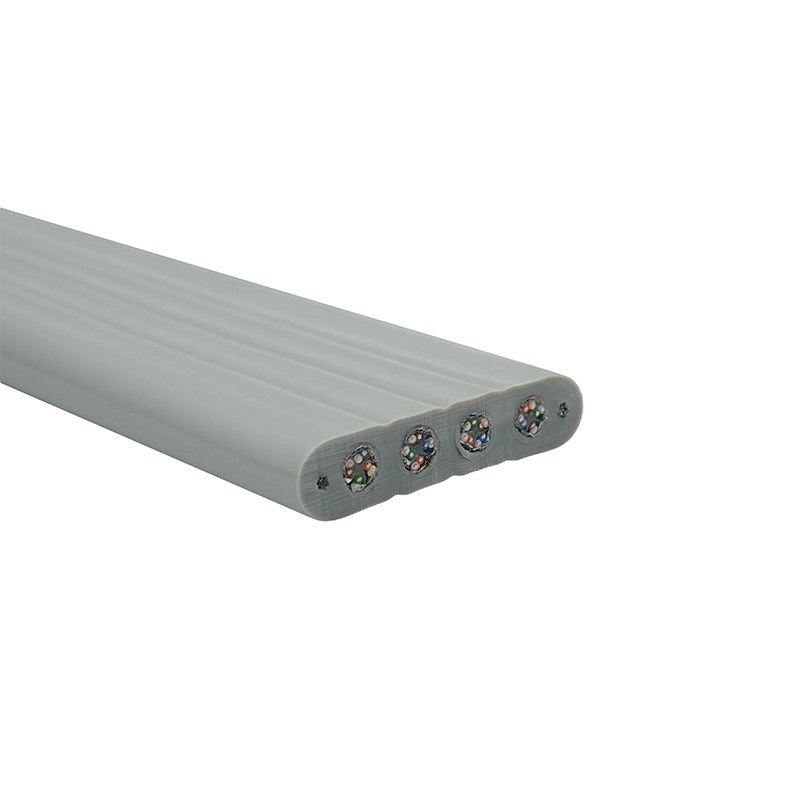
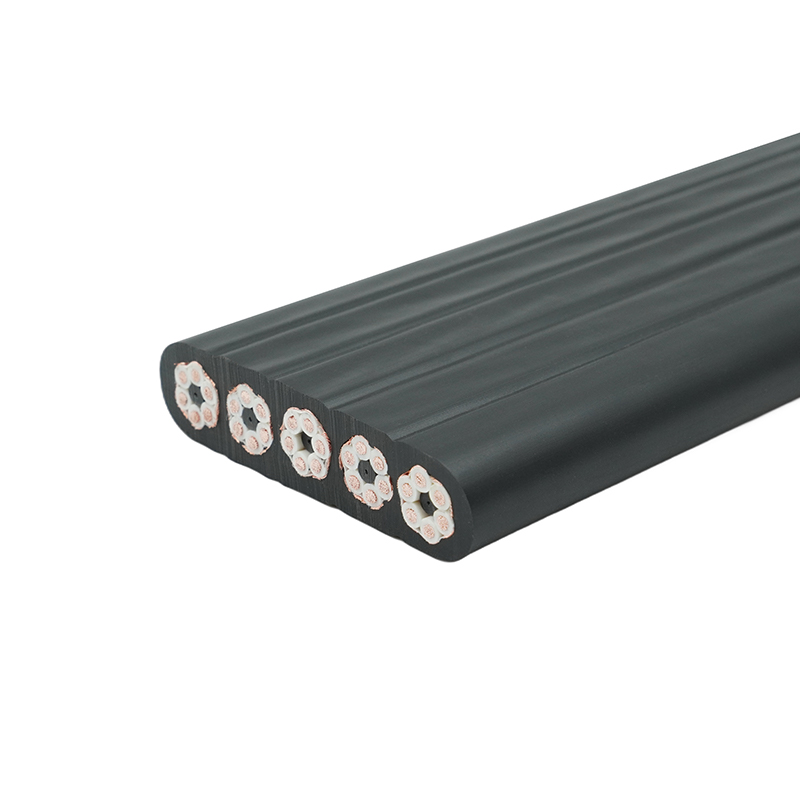 YFFBP Shielded Compound Sheath Crane Traveling Flat CableWith paired twisting and dense copper braid shielding, this flat cable keeps variable-frequency drive noise away from control and feedback signals, and can combine power, control, and data cores side by side in moving equipment.View Product →
Installation and Maintenance Practices
Most premature festoon failures trace back to installation rather than cable quality. Four practices prevent the common ones:
- Use clamps matched to the flat profile and grip the sheath without cutting into it, with strain relief at every clamp point.
- Let the tension member carry the hanging load; if the copper cores bear weight, the trolley spacing is too wide or the cable lacks a strength member.
- Respect the minimum bending radius at every trolley and where the cable enters the moving equipment — a tighter loop quietly shortens flex life.
- Confirm that the loops clear the track and nearby structure through full travel, in both directions, before handover.
Maintenance is mostly observation. During scheduled downtime, check for sheath abrasion, clamp slippage, loop twist, and discoloration at bend points. A flat festoon cable usually signals end of life through sheath cracking or visible flattening at the loops well before an electrical fault appears, so replacing it at that stage avoids unplanned crane stoppage.
Working With a Manufacturer
For festoon cable, buying decisions revolve less around catalog price and more around construction transparency. Ask any supplier for the conductor stranding class, sheath compound, tension member type, minimum bending radius, and flex-test data, plus the exact scope of each certification claimed. Customization is routine in this segment — core counts, gauge mixes, sheath compounds, and printed meter marks are standard requests to a special-cable manufacturer, and a factory that produces and tests in house, holding certifications such as CCC, UL, CE, and ISO9001, can align a custom flat construction with the approval your market requires.
Our own flat cable portfolio — crane, elevator, and general flat constructions in PVC, rubber, and compound sheaths — is described in more detail in our guide to flat cable types, structure, and industrial applications.
Key Takeaways
- Flat festoon cable is the default for festoon electrification because flat loops stack, clamp, and bend more predictably than round cable.
- Construction — fine-stranded conductors, matched sheath compound, integrated tension member, and optional shielding — decides service life more than price does.
- Size cores for current and voltage drop over the full travel distance, and match loop geometry to the minimum bending radius.
- For long travel or high speed, compare festoon electrification with motorized reeling before committing.
- Buy from manufacturers who publish construction details and hold certification for your destination market.
A festoon cable is a wear part with a long tail: chosen well, it runs quietly for years; chosen poorly, it fails in the middle of a shift. The difference is almost always in the details covered above.